


The BIKAI HPLC system is a full-featured liquid chromatography platform with configurations from isocratic to quaternary gradient, preparative, and bio-inert — with the UHPLC 1521 series reaching up to 16,000 PSI. FDA 21 CFR Part 11 compliant EyouLab software with GMP/GLP audit trails. Available in India through GBS Bengaluru. For pharma QC, food safety, or academic research — this guide walks you through every configuration so you choose exactly the right system for your application and budget. Call us: +91 97436 20456.
UHPLC 1521 series
Iso to Prep to Bio
at 1 mL/min
EyouLab software
What Is an HPLC System and Why Does It Matter for Indian Labs?
High Performance Liquid Chromatography (HPLC) is the most widely used analytical separation technique in the world — and in India, it sits at the heart of pharmaceutical quality control, food safety testing, environmental analysis, and academic research. An HPLC system separates the chemical components of a liquid sample by pushing it under high pressure through a column packed with a stationary phase. Components with different affinities for the stationary phase travel at different speeds, eluting from the column at different times and being detected by UV, PDA, fluorescence, or other detectors.
For Indian labs in 2026, choosing the right HPLC system means navigating a complex set of variables: regulatory compliance (CDSCO Schedule M, FDA 21 CFR Part 11 for export-oriented pharma), sample throughput (50–500+ injections per day for pharma QC vs 5–20 for academic research), mobile phase compatibility (standard pH vs extreme pH for biological samples), detector type (UV for routine methods vs PDA for peak purity confirmation), and budget vs capability tradeoffs that are especially relevant for DST/DBT grant-funded academic labs.
The BIKAI HPLC platform — supplied in India by GBS — addresses this full range. Six distinct configurations cover every use case from a basic isocratic system for routine API assay to a preparative HPLC for compound isolation and a UHPLC for high-speed, high-resolution separation. All share the same FDA 21 CFR Part 11 compliant EyouLab software platform.
Indian pharmaceutical manufacturers exporting to US and EU markets must operate HPLC systems under FDA 21 CFR Part 11 and EU Annex 11 guidelines for data integrity. Domestic pharma QC must comply with CDSCO Schedule M. Food testing labs require NABL accreditation with instrument qualification records. All BIKAI HPLC systems are supplied with the EyouLab data system that meets all these requirements and supports IQ/OQ/PQ qualification documentation.
BIKAI HPLC Configurations — Which One Is Right for You?
The BIKAI HPLC platform is not a single instrument — it is a modular analytical system available in six distinct configurations, each optimized for a different application profile. Understanding the differences is the first step in selecting the right system for your lab's specific requirements.
Isocratic HPLC System
Single solvent composition. Simplest configuration for routine single-method QC testing. Ideal for simple, well-established assays where gradient is not required.
Binary Gradient HPLC
Two-solvent gradient for impurity profiling, dissolution testing, and multi-component separation. The most common configuration in Indian pharma QC labs.
Quaternary Gradient HPLC
Four-solvent programmable gradient. Maximum method flexibility for complex separations, metabolite profiling, and method development workflows.
Bio-Inert HPLC System
PEEK and titanium fluid pathways. Eliminates metal-induced sample adsorption. Essential for proteins, peptides, nucleotides, and extreme pH applications (pH 1–12.5).
Preparative HPLC System
High flow rates up to 150 mL/min. Large-bore columns for milligram-to-gram scale compound isolation. Used in API synthesis, natural product isolation, and biotech purification.
UHPLC System
Up to 16,000 PSI with sub-2µm columns. Faster run times, higher resolution, lower solvent consumption. For high-throughput pharma QC and complex biological matrices.
BIKAI 1511 Preparative HPLC System — Compound Isolation at Scale
BIKAI 1511 Preparative HPLC
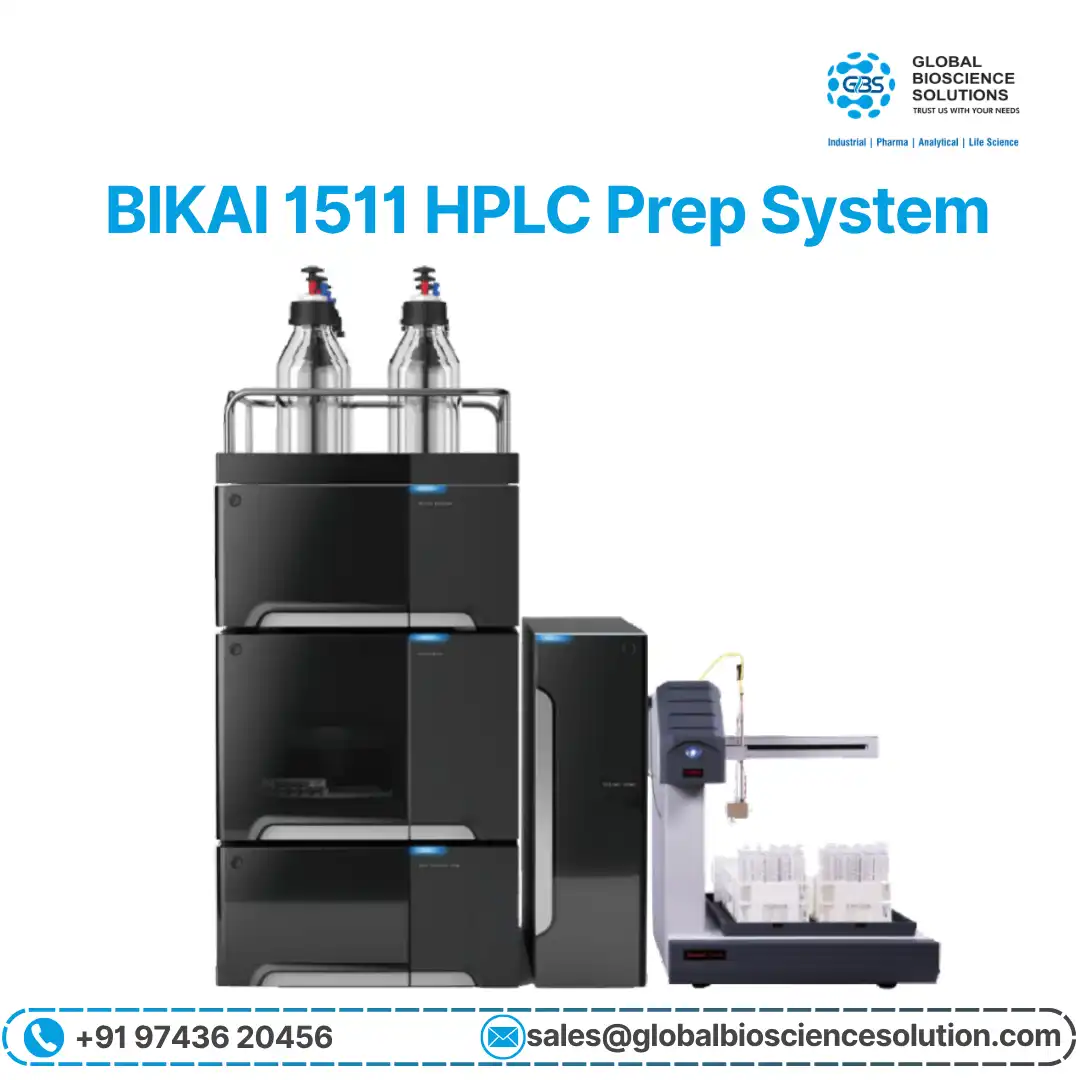
The BIKAI 1511 Preparative HPLC system is designed for large-scale compound isolation and purification — from API intermediates and natural products to peptides and oligonucleotides. Supporting flow rates up to 150 mL/min through large-bore preparative columns, it enables milligram-to-gram scale purification in a single system. The modular design accepts standard analytical columns as well as large-diameter preparative columns without reconfiguration, making it a dual-purpose system for labs that need both analytical characterisation and preparative isolation. The same FDA 21 CFR Part 11 compliant EyouLab software manages automated fraction collection, peak-triggered collection, and full run documentation for GMP compound isolation workflows.
Preparative HPLC Applications in Indian Research & Pharma
- API intermediate isolation — purifying synthetic drug intermediates and final APIs from reaction mixtures in pharmaceutical manufacturing development
- Natural product isolation — large-scale purification of bioactive compounds from plant extracts, marine organisms, and microbial fermentation broths for drug discovery research
- Peptide and oligonucleotide purification — HPLC-grade purification of synthesised peptides, small interfering RNA, and other biomolecules from synthesis impurities
- Reference standard preparation — isolating pharmacopoeial-grade reference standards for method validation and instrument calibration
- Biosimilar development — fraction collection of protein subunits for characterisation in biologics development workflows
BIKAI 1511 Bio-Inert HPLC — Metal-Free Pathways for Biological Samples

BIKAI 1511 Bio-Inert HPLC
The BIKAI 1511 Bio is the essential instrument for any lab analysing biological macromolecules, metal-sensitive compounds, or samples requiring extreme pH gradients. All fluid pathways — pumps, autosampler, column connection, and detector flow cell — are constructed from PEEK polymer and titanium rather than stainless steel. This eliminates metal-ion leaching that causes protein adsorption, peak tailing, and analyte loss in conventional HPLC systems. The bio-inert configuration supports mobile phase pH from 1.0 to 12.5, enabling both highly acidic ion-pairing methods for nucleotides and highly alkaline carbohydrate analysis. For Indian biotech labs, biosimilar developers, and protein purification workflows, the Bio-Inert HPLC is not an optional upgrade — it is a technical necessity that protects sample integrity and analytical accuracy.
Full Technical Specifications — BIKAI HPLC & UHPLC
The following table consolidates the key technical specifications for the BIKAI 1511 HPLC series (standard, preparative, and bio-inert) and the 1521 UHPLC series. Use this for direct comparison and to verify compatibility with your analytical methods and column requirements.
| Parameter | BIKAI 1511 HPLC Standard | BIKAI 1511 Bio Bio-Inert | BIKAI 1511 Prep Preparative | BIKAI 1521 UHPLC Ultra HP |
|---|---|---|---|---|
| Max operating pressure | 10,500 PSI | 10,500 PSI | 10,500 PSI | 16,000 PSI |
| Pump type | Series double-plunger | PEEK double-plunger | High-flow double-plunger | Ultra-high pressure dual-plunger |
| Pressure pulsation | <1% | <1% | <1% | <0.5% |
| Flow rate range | 0.001–10 mL/min | 0.001–10 mL/min | 0.001–150 mL/min | 0.001–10 mL/min |
| Flow rate precision | ≤0.1% RSD | ≤0.1% RSD | ≤0.1% RSD | ≤0.1% RSD |
| Fluid pathway material | Stainless steel | PEEK + Titanium | Stainless steel | Stainless steel / PEEK option |
| pH range | 1–9 | 1.0–12.5 | 1–9 | 1–9 |
| Gradient configurations | Isocratic, Binary, Quaternary | Binary, Quaternary | Binary, Quaternary | Binary, Quaternary |
| UV detector range | 190–900 nm | 190–900 nm | 190–900 nm | 190–900 nm |
| PDA detector pixels | 1024-pixel | 1024-pixel | 1024-pixel | 1024-pixel |
| Autosampler capacity | Up to 4×96-well plates | Up to 4×96-well plates | Vial rack formats | Up to 4×96-well plates |
| Column oven range | 4°C – 85°C | 4°C – 85°C | RT – 85°C | 4°C – 85°C |
| Software | EyouLab (Chromal) — FDA 21 CFR Part 11, GMP/GLP, GMP audit trail | |||
| Regulatory compliance | FDA 21 CFR Part 11 · EU GMP Annex 11 · Schedule M / CDSCO · NABL instrument qualification | |||
| Best applications | Routine pharma QC, food testing | Proteins, peptides, bio samples | Compound isolation, API purification | High-throughput QC, impurity profiling |
Key Features of the BIKAI HPLC System Explained
Double-Plunger Pump with Pulsation Suppression
The BIKAI HPLC uses a series double-plunger reciprocating pump mechanism that eliminates the need for external dampers — a common source of flow irregularity in entry-level HPLC systems. Pressure pulsation is maintained strictly below 1% RSD, ensuring a stable baseline and reproducible peak areas across long analytical sequences. For pharmaceutical impurity profiling where ICH Q3 thresholds demand quantification accuracy at the 0.05–0.1% level, pump stability is not a secondary concern — it is the foundation of method reliability.
FDA 21 CFR Part 11 Compliant EyouLab Software
The EyouLab data system is built from the ground up for regulatory compliance rather than retrofitted with a compliance module. It provides: complete immutable audit trails for all data changes and deletions, electronic signatures with operator authentication, user access management with 21 CFR-compliant role hierarchies, networkable operation for multi-station data management, automated peak width algorithms for consistent integration, and full GMP/GLP report generation. For Indian pharmaceutical manufacturers seeking USFDA approval or preparing for WHO-GMP audits, EyouLab provides the data integrity framework required without additional third-party software.
High-Performance Detector Options — UV vs PDA
The BIKAI HPLC is configurable with two primary detector types, each suited to different analytical workflows. The UV-Vis detector (190–900 nm wavelength range with programmable wavelength switching) is the standard choice for routine quantitative assays where the chromophore characteristics of your analyte are well established — API content analysis, dissolution testing, and most pharmacopoeial methods. The PDA (photodiode array) detector with 1024-pixel resolution collects a full UV spectrum at every data point, enabling peak purity confirmation (essential for impurity profiling under ICH guidelines), peak identification by spectral matching, and simultaneous detection of multiple analytes at their respective optimal wavelengths — critical for complex multi-component pharmaceutical formulations and food contaminant screening.
Advanced Autosampler — Up to 4×96-Well Plates
The BIKAI autosampler supports full loop, partial loop, and µL pick-up injection modes, with optional cooling capability for thermally sensitive biological samples. The large autosampler capacity — supporting up to four 96-well plates — enables unattended overnight runs of 300+ samples, dramatically reducing labour costs and instrument downtime in high-throughput pharmaceutical QC environments. Automated carry-over prevention wash sequences are programmable between samples for applications where cross-contamination risk must be minimised.
HPLC Applications for Indian Laboratories
Pharmaceutical API Testing
API assay, content uniformity, dissolution testing, and impurity profiling per IP/BP/USP/EP pharmacopoeial methods. GMP compliant with Schedule M documentation support.
Food Safety & Pesticide Residue
Pesticide residue testing, mycotoxin screening (aflatoxins, ochratoxin), preservative identification, and food colour quantification for FSSAI-accredited laboratories.
Environmental Analysis
Polycyclic aromatic hydrocarbons (PAH), phenols, and herbicide analysis in water and soil samples for environmental monitoring and regulatory compliance testing.
Academic & Industrial Research
Method development, unknown compound identification (with PDA), natural product characterisation, and metabolite profiling in university and CRO research labs.
Biotechnology & Biosimilars
Protein characterisation, peptide mapping, biosimilar comparability studies, and oligonucleotide purity analysis using bio-inert configuration.
Cosmetics & Personal Care Testing
Preservative content, UV filter analysis, and heavy metal-free verification in cosmetics manufacturing QC for Bureau of Indian Standards compliance.
HPLC vs UHPLC — Which Does Your Indian Lab Need?
The decision between standard HPLC (BIKAI 1511) and UHPLC (BIKAI 1521) comes down to throughput requirements, sample complexity, and budget. The following framework helps Indian lab managers make the right call.
Buying an HPLC System in India — Procurement, Compliance & Support
Procuring an HPLC system in India involves considerations specific to the local regulatory and procurement ecosystem. GBS manages the complete process — from quotation and specification documents to installation qualification and after-sales support.
GeM Portal, DST/DBT Grant Procurement
GBS provides all necessary documentation for GeM portal procurement, institutional purchase orders, and grant-funded acquisitions under DST, DBT, SERB, CSIR, and ICMR schemes. For academic institutions requiring UHPLC for analytical chemistry or pharmaceutical sciences departments, GBS can prepare technical specification documents, comparative quotations, and the vendor registration documents required for GeM compliance. Contact our team for a quotation with full GeM-compatible documentation.
Installation Qualification (IQ), Operational Qualification (OQ) & Performance Qualification (PQ)
All BIKAI HPLC systems supplied by GBS include on-site installation by a qualified applications engineer. For pharmaceutical and food testing labs requiring NABL accreditation or CDSCO audit readiness, GBS provides formal IQ/OQ/PQ documentation at installation — the written record that the instrument was correctly installed, operates within specification, and performs accurately for its intended analytical method. This documentation package is prepared to GMP standards and includes system suitability test data with your laboratory's specific methods.
Training, Method Transfer & After-Sales Service
All HPLC system installations include operator training covering EyouLab software operation, method programming, system suitability testing, and routine maintenance procedures (seal replacement, degasser maintenance, lamp replacement). Method transfer support is available for labs migrating existing HPLC methods from other instrument platforms to the BIKAI system. Annual maintenance contracts and corrective maintenance services are available across India from GBS's Bengaluru service centre.
Related Analytical Products from GBS
- BIKAI 1521 UHPLC System — ultra-high performance liquid chromatography for sub-2µm columns at up to 16,000 PSI
- Blue Ray EzDrop 1000 Spectrophotometer — micro-volume UV-Vis spectrophotometer for DNA, RNA, and protein quantification before chromatographic analysis
- Blue Ray EzCube Fluorometer — sensitive fluorometric quantification for samples requiring detection below UV spectrophotometer limits
- Quorum Sputter Coaters — SEM sample preparation for material science labs running parallel microscopy and chromatography workflows
- All GBS Technical Guides — sputter coater selection, plasma cleaning, PCR thermal cyclers, and more
Frequently Asked Questions — HPLC System India 2026
Structured with FAQPage schema for AI search engines (ChatGPT, Perplexity, Gemini, Claude) and Google Featured Snippets.