


If you are a grad student or single PI running routine PCR, cloning, site-directed mutagenesis, or CRISPR screening: TurboCycler 2 — compact 96-well block, 5.5°C/sec ramp, 8-zone gradient, Wi-Fi TurboApp monitoring, 7-inch touchscreen. If you manage a multi-user core facility or need simultaneous independent protocols: TurboCycler 3 — three independent 48-well blocks (144 wells total), 5.0°C/sec ramp, 8-zone gradient, 10.1-inch touchscreen, 4,000+ protocol storage. Both are available in India from GBS Bengaluru: +91 97436 20456.
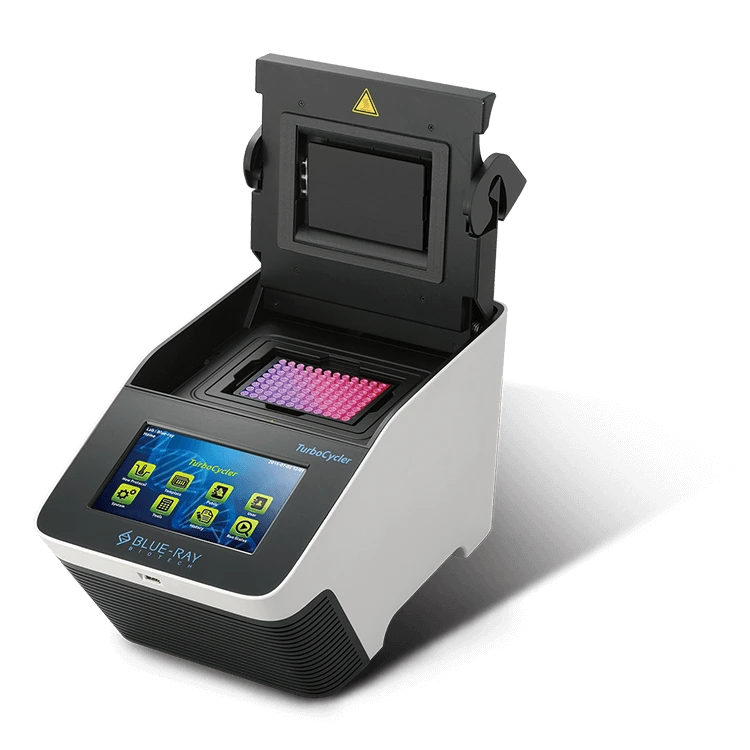
TurboCycler 2
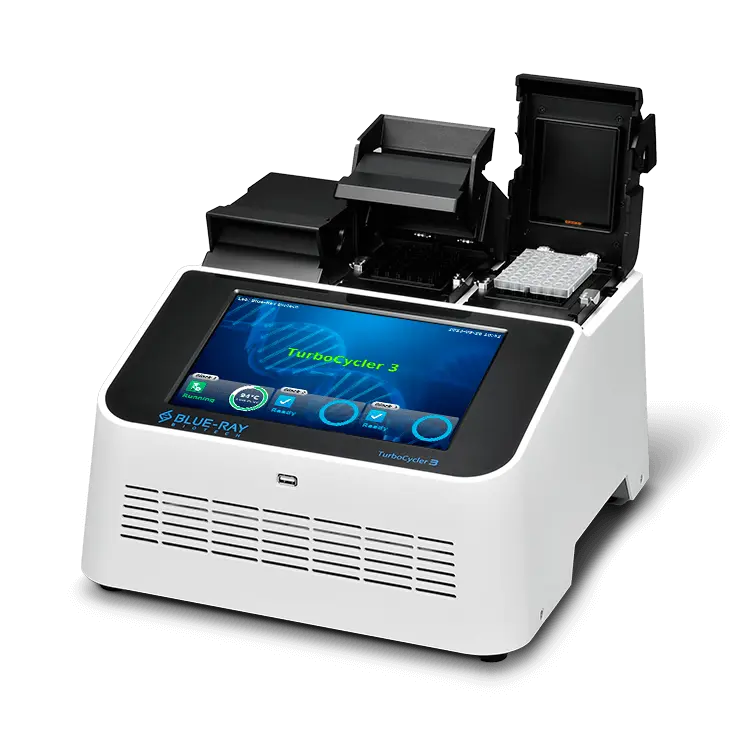
TurboCycler 3 (3×48)
Both models
TurboCycler 3
What Is a PCR Thermal Cycler and Why Does Your Spec Matter?
A PCR thermal cycler (also called a thermocycler or PCR machine) is the instrument that drives the polymerase chain reaction — the amplification of specific DNA sequences through repeated cycles of denaturation, annealing, and extension. The thermal cycler precisely controls the temperature at which these steps occur, how fast it transitions between temperatures, and how long it holds each temperature — and these specifications determine whether your PCR works efficiently or gives you frustrating, inconsistent results.
For Indian molecular biology researchers in 2026, the choice of thermal cycler matters for reasons beyond basic temperature control. Fast ramp rates determine how many PCR runs you can complete in a day. Gradient capability determines how quickly you can optimise new primer sets without wasting a week running individual reactions at different annealing temperatures. Multi-block design determines whether your lab's PCR machine creates a queue bottleneck or runs smoothly as a shared instrument. Wi-Fi monitoring determines whether you're chained to the bench or can work elsewhere while your PCR runs. These are the real-world performance factors that separate modern thermal cyclers from legacy instruments — and the criteria this guide evaluates.
What Specs Actually Matter for Indian Research Labs?
- Ramp rate (°C/sec) — how fast the block heats and cools. Higher ramp rate = shorter cycle time = more PCR runs per day. For a 30-cycle PCR with 30-second transitions, the difference between 2°C/sec and 5.5°C/sec can save 20–30 minutes per run — critical when you're running 3–5 PCR experiments daily.
- Gradient capability — the ability to run different annealing temperatures simultaneously across the block. Essential for primer optimisation and a near-mandatory feature for any modern research lab. The 8-zone gradient in both TurboCycler models tests 8 temperatures simultaneously in one experiment.
- Temperature uniformity — how closely all wells on the block match the set temperature. Poor uniformity means reactions in different well positions give different results. Both TurboCycler models achieve ±0.2–0.3°C uniformity — excellent for sensitive applications.
- Block capacity and throughput — single-block vs multi-block instruments determine whether your PCR machine is a per-researcher instrument or a shared facility resource. For Indian labs with 5–15 PhD students sharing one instrument, block capacity directly affects research productivity.
- Connectivity and remote monitoring — Wi-Fi TurboApp connectivity on the TurboCycler 2 allows researchers to monitor runs from their phone, receive completion alerts, and avoid wasted waiting time at the bench.
- Power failure auto-restart — India's power infrastructure in some cities and campuses experiences frequent outages. Both TurboCycler models include automatic power failure restart, resuming the protocol from the current step when power is restored — protecting overnight and long-run samples.
Both the TurboCycler 2 and TurboCycler 3 include automatic power failure auto-restart. When power is restored after an outage, the instrument resumes the cycling protocol from the point of interruption, protecting your samples. This is not a universal feature in thermal cyclers at this price point — and for labs in campuses with unreliable power supply, it directly prevents loss of irreplaceable samples and wasted reagents.
Understanding Gradient PCR — Why It Matters for Your Research
Of all thermal cycler features, gradient capability has arguably the highest practical impact on day-to-day research productivity in India. Here is why.
Every PCR reaction requires an annealing temperature — the temperature at which your primers bind to the template DNA. If the annealing temperature is too high, primers won't bind and you get no product. Too low and they bind non-specifically, producing smears or multiple bands. The optimal annealing temperature is typically estimated from primer melting temperature (Tm), but the actual optimum varies with primer length, GC content, buffer composition, template complexity, and polymerase — and must be determined empirically for any new primer pair.
Without gradient capability, primer optimisation requires running individual PCR reactions at each annealing temperature — one tube at 50°C, one at 52°C, one at 54°C, and so on. On a non-gradient instrument, this requires 6–8 separate PCR runs, consuming 2–3 hours of instrument time, multiple PCR setups, and significant reagent cost.
With an 8-zone gradient block, all 8 annealing temperatures are tested simultaneously in a single PCR run. One setup, one reaction, 45–90 minutes, and you have your optimal annealing temperature. For a PhD student regularly working with new primers — cloning, mutagenesis, genotyping, CRISPR validation — this time saving compounds significantly over a research project lifetime.
How the 8-Zone Gradient Works in Both TurboCycler Models
The 8-zone gradient in both TurboCycler 2 and TurboCycler 3 divides the block into 8 temperature zones arranged in rows. Each zone maintains a different, independently controlled temperature. The gradient span (the difference between the coolest and hottest zone) can be set from 1°C up to 30°C. A typical primer optimisation gradient might be set from 52°C to 68°C across the 8 zones — meaning zone 1 runs at 52°C, zone 2 at 54°C, zone 3 at 56°C, and so on up to zone 8 at 68°C, all within a single PCR run.
The TurboCycler 3's gradient range is 30–100°C, giving broader flexibility for high-temperature applications. The TurboCycler 2's gradient span is 1–30°C — more than adequate for the 50–70°C annealing temperature range used in virtually all routine PCR. Both instruments display the calculated temperature for each gradient zone on the screen before you start the run.
Blue Ray TurboCycler 2 — Complete Product Guide
Blue Ray TurboCycler 2
The TurboCycler 2 is an ultra-compact high-performance gradient PCR thermal cycler designed for modern molecular biology research. Its 5.5°C/sec maximum ramp rate is among the fastest in its class — completing standard 35-cycle PCR protocols in under 60 minutes. Built around a precision 96-well block with 8-zone gradient capability, it handles everything from routine colony PCR to CRISPR screen amplification, site-directed mutagenesis, and long-range PCR. The 7-inch capacitive touchscreen and built-in Wi-Fi with TurboApp smartphone monitoring make it the most user-friendly PCR machine available in this category in India.
TurboCycler 2 Key Features in Depth
5.5°C/sec Ramp Rate — What It Means in Practice
The TurboCycler 2's maximum ramp rate of 5.5°C/sec is one of the fastest available in the 96-well compact thermal cycler segment. In a typical PCR protocol with transitions from 95°C (denaturation) to 60°C (annealing) — a 35°C temperature drop — a 5.5°C/sec ramp completes the transition in about 6.4 seconds. A slower instrument at 2°C/sec takes 17.5 seconds for the same transition. With 35 cycles and 4 transitions per cycle, this difference accumulates to over 16 minutes saved per run. For a grad student running 4 PCR experiments per day, this means finishing experiments measurably earlier — with more time for gel analysis, cloning, or leaving the lab at a reasonable hour.
Wi-Fi TurboApp Remote Monitoring
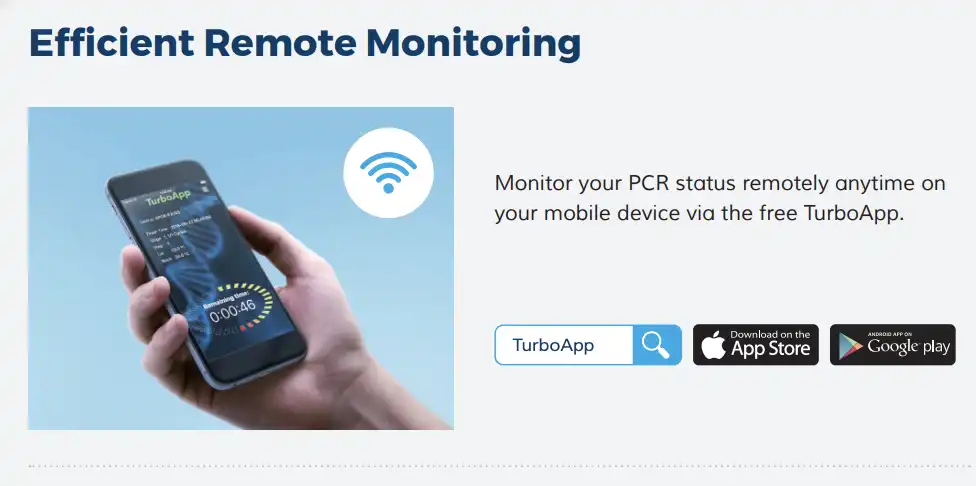
The TurboCycler 2 includes built-in Wi-Fi that connects to the TurboApp mobile application. Researchers can monitor the progress of active PCR runs from any location — their office, another lab room, or the library. The app sends a notification when a run completes, preventing the common scenario where a researcher returns to the lab 45 minutes after their PCR finished and the samples have been sitting in the heated lid unnecessarily. For overnight runs and long cycling programs, TurboApp provides real-time run status at a glance. Protocol management and run history are also accessible through the app.
7-Inch Glove-Friendly Capacitive Touchscreen
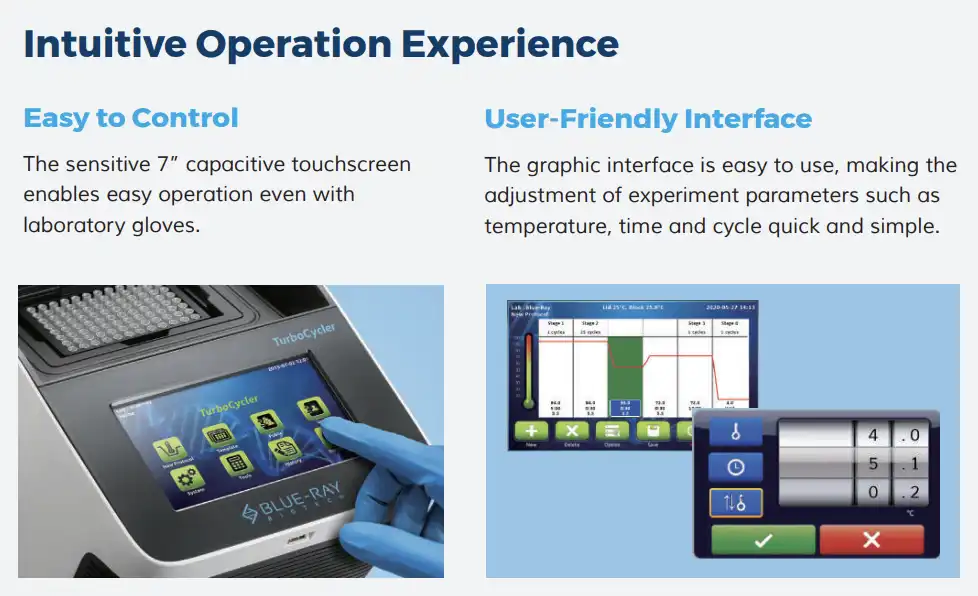
The TurboCycler 2's 7-inch LED-backlit capacitive touchscreen operates like a modern smartphone display — responsive, high-contrast, and usable while wearing nitrile gloves. Protocol programming is quick and intuitive: enter step temperatures, hold times, cycle numbers, and gradient settings directly on screen. Stored protocols can be named, edited, copied, and run directly from the home screen. For labs where multiple users program the instrument — graduate students, postdocs, technicians — the familiar smartphone-style interface significantly reduces training time and eliminates the menu-navigation complexity of older thermal cycler interfaces.
TurboCycler 2 PCR Applications
Routine Colony PCR
Fast ramp rate and compact footprint make the TurboCycler 2 ideal for daily colony screening in cloning workflows.
CRISPR Guide RNA Validation
CRISPR-optimised ramp rate ensures precise amplification for T7E1 assay and sequencing-based CRISPR edit screening.
Site-Directed Mutagenesis
8-zone gradient enables rapid annealing temperature optimisation for mutagenic primer sets with demanding specificity requirements.
Genotyping
High-throughput genotyping of transgenic lines, knockout cell pools, and patient samples at consistent 96-well format.
Pharmaceutical QC PCR
Identity testing, mycoplasma detection, and sterility testing PCR in pharma QC labs — with TurboApp audit trail logging.
Plant & Pathogen Diagnostics
Agricultural research, plant transformation screening, and phytopathogen detection PCR in field-sample laboratories.
Blue Ray TurboCycler 3 — Triple-Block Complete Product Guide
Blue Ray TurboCycler 3
The TurboCycler 3 is the most advanced high-throughput PCR thermal cycler in its class — a triple-block instrument that runs three completely independent 48-well PCR programs simultaneously in one benchtop unit. Each of the three blocks has its own Peltier heating and cooling system, its own independent temperature controller, and its own independently programmed PCR protocol. Three different researchers can run three different PCR experiments at different temperatures, different cycle numbers, and different gradient settings — at the same time, with zero inter-block interference. The TurboCycler 3 effectively replaces three separate thermal cyclers in the footprint of one.
TurboCycler 3 Key Features in Depth
Three Truly Independent 48-Well Blocks — The Core Innovation
The defining feature of the TurboCycler 3 is its three genuinely independent blocks. "Independent" means more than just separate wells — each block has its own dedicated Peltier heating/cooling element, its own temperature feedback and control system, and its own protocol scheduler. Block 1 can be at 55°C annealing for a standard cloning PCR while block 2 is at 72°C extension for a long-range PCR while block 3 is in a gradient protocol testing annealing temperatures from 58°C to 72°C. All three simultaneously. No thermal crosstalk, no temperature compromise from shared heating elements. This architecture is fundamentally different from instruments that use a single Peltier split across multiple zones.
Tool-Free Interchangeable Blocks
The TurboCycler 3's block modules are interchangeable without tools — unlocked, lifted out, and replaced in seconds. This serves two purposes. First, it enables rapid maintenance: if one block develops an issue, it can be removed and replaced without taking the entire instrument offline. The other two blocks continue operating. Second, it enables future format flexibility: different block configurations can be swapped in as workflows evolve. For a multi-user core facility handling instruments booked 8–10 hours per day, this design significantly reduces downtime risk compared to fixed-block instruments.
10.1-Inch Colour Touchscreen and 4,000+ Protocol Storage
The TurboCycler 3's 10.1-inch colour touchscreen provides clear visibility of all three blocks simultaneously — showing the current temperature, step name, cycle number, and time remaining for each block independently on a single screen. The instrument stores over 4,000 named protocols internally, meaning every researcher in a multi-user facility can have their own protocol library stored on the instrument. Protocol import/export via USB allows institutional protocol sharing and backup. For facilities managing multiple PCR workflows across different research groups, centralised protocol storage eliminates the frustration of re-programming frequently-run protocols.
TurboCycler 2 vs TurboCycler 3 — Head-to-Head Comparison
The following table gives a complete side-by-side specification comparison of the TurboCycler 2 and TurboCycler 3. Use this to identify the features relevant to your lab's specific workflow requirements.
| Specification | TurboCycler 2 | TurboCycler 3 |
|---|---|---|
| Block configuration | 1 × 96-well block | 3 × 48-well independent blocks |
| Total sample capacity | 96 × 0.2 mL tubes | 144 × 0.2 mL tubes |
| Max ramp rate | 5.5°C/sec | 5.0°C/sec |
| Gradient zones | 8-zone gradient | 8-zone gradient |
| Gradient span | 1–30°C | 30°C span over 30–100°C range |
| Temperature uniformity | ±0.3°C | ±0.25°C |
| Temperature accuracy | Standard | ±0.2°C at 55°C |
| Lid temperature | 35–120°C | 105°C / 130°C (per block) |
| Display | 7-inch touchscreen | 10.1-inch colour touchscreen |
| Protocol storage | Standard | >4,000 protocols |
| Wi-Fi / TurboApp | ✓ Built-in Wi-Fi + TurboApp | USB data export |
| Independent simultaneous runs | ✗ Single block | ✓ 3 simultaneous programs |
| Interchangeable blocks | ✗ Fixed block | ✓ Tool-free swap |
| Power failure auto-restart | ✓ | ✓ Each block independently |
| Heating/cooling system | Peltier | Advanced Peltier per block |
| Footprint | Compact benchtop | Mid-size benchtop |
| Target users | Individual researcher, small lab | Multi-user lab, core facility, CRO |
Which Thermal Cycler Is Right for Your Indian Lab?
Use this decision guide to match your laboratory situation to the recommended instrument. These recommendations are based on common Indian university, pharmaceutical, and biotech lab configurations.
Buying a PCR Thermal Cycler in India — What You Need to Know
Procuring laboratory instruments in India involves considerations specific to the local procurement ecosystem. GBS, as the authorized Blue Ray Biotech distributor in India, manages the end-to-end process — from quotation and import to installation and after-sales support.
Import, Pricing & GeM Portal Procurement
Blue Ray Biotech instruments are imported under correct HS codes with standard IGST treatment. GBS provides complete documentation for GeM portal procurement, institutional purchase orders, and grant-funded acquisitions under DST, DBT, SERB, CSIR, and ICMR schemes. For IITs and national labs purchasing via CPPP/GeM, GBS can provide the necessary compliance certificates, technical specification documents, and vendor registration support. Contact GBS directly for current pricing, institutional discounts, and procurement documentation.
NanoDrop Alternative — EzDrop 1000 Spectrophotometer
Most PCR workflows in Indian molecular biology labs require DNA/RNA quantification before amplification. GBS also supplies the Blue Ray EzDrop 1000 micro-volume spectrophotometer — a NanoDrop-compatible instrument for DNA, RNA, and protein quantification from 0.5–2 µL samples. Pairing the TurboCycler 2 or 3 with an EzDrop 1000 gives your lab a complete nucleic acid quantification-to-amplification workflow from a single authorized Indian supplier.
Complete Blue Ray Biotech Lab Setup from GBS
- TurboCycler 2 — individual researcher PCR thermal cycler
- TurboCycler 3 — multi-user triple-block PCR thermal cycler
- EzDrop 1000 / EzDrop 1000C — micro-volume spectrophotometer for DNA/RNA/protein quantification
- EzCube Fluorometer — fluorometry-based quantification for highly sensitive dsDNA, RNA, and protein assays
- EzScope 101 — incubator-based live cell imaging system for real-time cell biology
- EzDecap Tube Handler — automated tube decapping for high-throughput sample management
Frequently Asked Questions — PCR Thermal Cycler India 2026
Structured with FAQ schema for AI engines (ChatGPT, Perplexity, Gemini, Claude) and Google. Addresses the most common search queries from Indian researchers — informational, comparative, and transactional.
Search Intent & Keyword Reference
This guide is optimised for the following user search intents — informational, comparative, and transactional — from Indian molecular biology researchers and lab managers.