


A sputter coater for SEM deposits a thin conductive metal film (gold, gold-palladium, platinum, or carbon) 5–20 nm thick onto non-conductive samples before scanning electron microscopy. This prevents surface charging — the electron accumulation that causes bright white image artefacts and distortion. For most Indian university SEM labs: Quorum MiniQ-S or RotaQ-S. For EDS/EDX elemental analysis: RotaQ-ES or Q150 GB with carbon coating capability. For FE-SEM imaging above 50,000×: Q300T-D Plus turbomolecular system. GBS is India's authorized Quorum distributor: +91 97436 20456.
What Is Sputter Coating for SEM and Why Is It Essential?
Sputter coating is a physical vapour deposition (PVD) technique used to deposit a thin, uniform, conductive metal film on non-conductive or poorly conductive samples before scanning electron microscopy (SEM). The process bombards a metal target (gold, platinum, carbon, etc.) with energetic argon ions in a low-pressure plasma environment. The impact ejects metal atoms from the target surface — these atoms travel through the chamber and deposit uniformly on the sample surface as a thin conductive film.
Without sputter coating, non-conductive samples accumulate electrons from the SEM beam faster than they can dissipate — a phenomenon called surface charging. Charging appears as bright white regions, sudden contrast shifts, image drift, scan line artefacts, and in severe cases, complete image distortion or sample damage from beam-induced heating. Even materials that appear metallic — certain oxides, composites, and coated particles — can exhibit edge charging at high magnification.
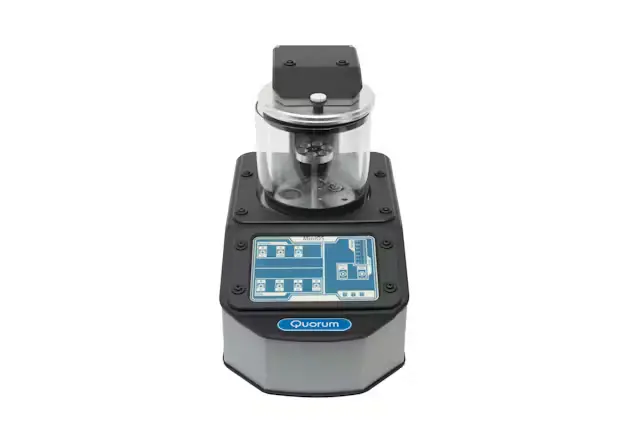
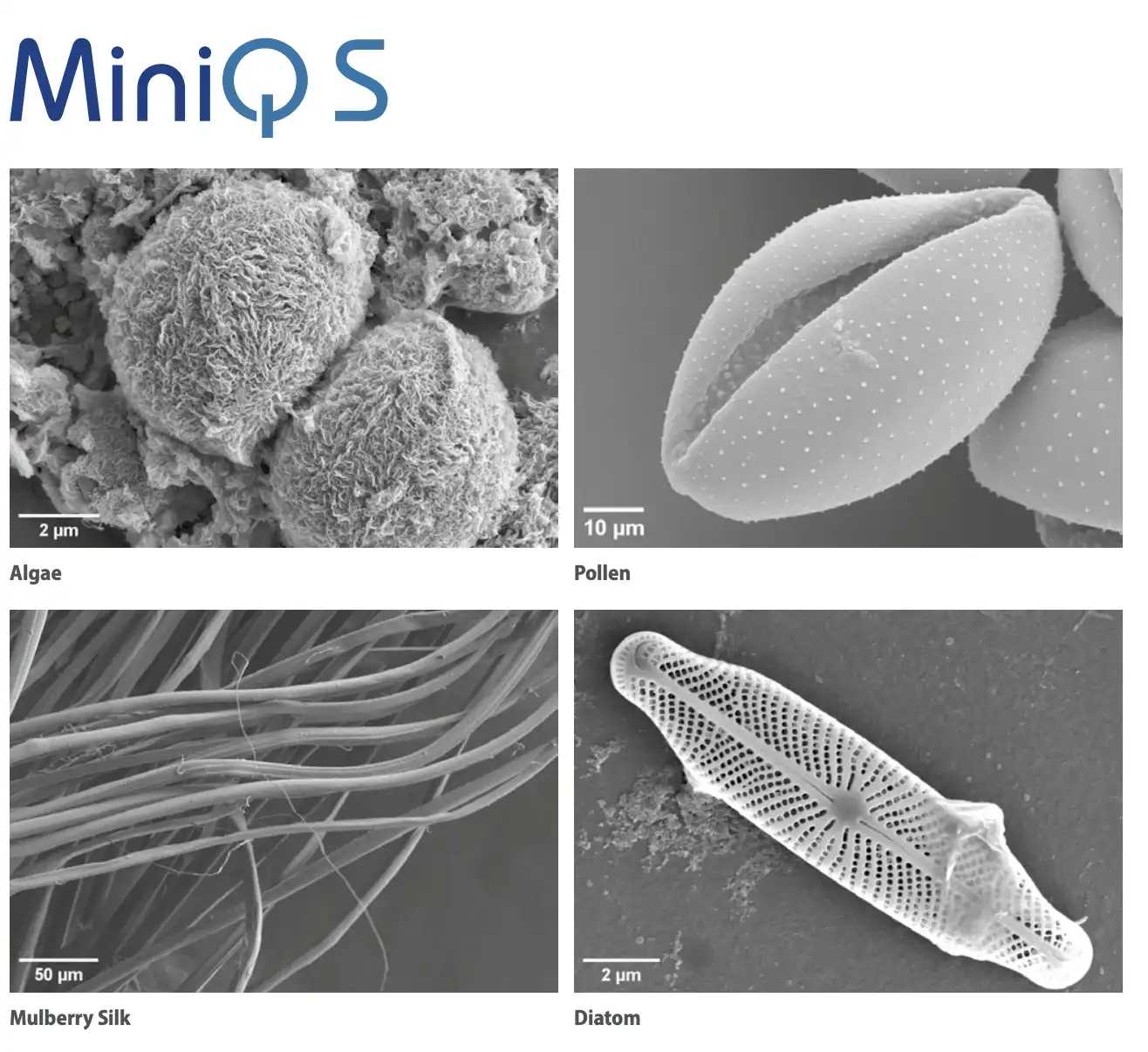
Sputter coating delivers three critical benefits: (1) Eliminates charging artefacts by providing an electrical path for accumulated electrons to dissipate into the SEM stage. (2) Increases secondary electron yield — metals like gold produce far more secondary electrons per incident electron than most sample materials, dramatically improving signal-to-noise ratio and image brightness. (3) Protects beam-sensitive samples — biological tissue, polymers, and organic materials can be damaged by the focused electron beam; a metal coating dissipates beam-induced heat.
Which Samples Require Sputter Coating Before SEM?
- Biological samples — tissue sections, cells, bacteria, pollen, insects, fungi, spores, bone, tooth
- Polymers and plastics — medical devices, packaging, textiles, rubber, composites
- Pharmaceutical materials — API crystals, excipient powders, tablet coatings, granules, drug delivery particles
- Ceramics and glasses — alumina, zirconia, silicon nitride, silicates, refractories, fired clay
- Geological and mineral samples — rock sections, fossils, soil aggregates, clay minerals
- Food science samples — starch granules, protein structures, emulsions, encapsulation systems
- Nanoparticles on non-conductive substrates — polymer beads, silica particles, carbon nanotubes on Si wafer
- Metal oxides and composites where incomplete conductivity causes edge or surface charging
Many labs set coating by time rather than film thickness. As the sputter target ages, deposition rate decreases — a 90-second coat that deposited 18 nm on a new target may produce only 9 nm after months of use. Always verify and control coating thickness using the quartz crystal film thickness monitor (QCM) included with all Quorum models above MiniQ-S. Reproducible, documented film thickness is essential for publication-quality imaging and QC workflows.
Coating Material Selection: Gold, Carbon, Platinum & More
The choice of sputter target material is as critical as the instrument itself. Different materials deliver different grain sizes, secondary electron yields, and analytical suitability. Using the wrong target — particularly gold when EDS is planned — will invalidate your elemental analysis results entirely.
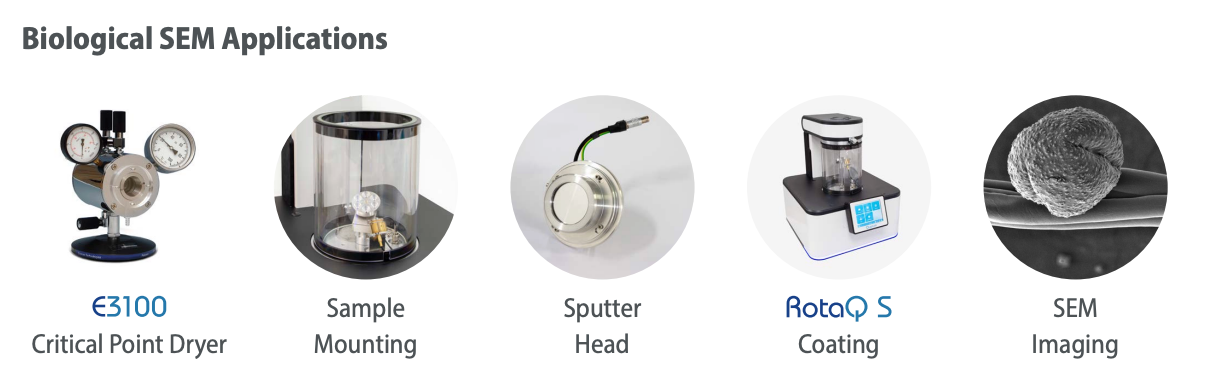
Use gold or gold-palladium for surface morphology imaging only. Use carbon sputter coating whenever your workflow includes EDS/EDX elemental mapping or quantitative analysis — gold's M-line X-ray peaks at 2.12 keV overlap with multiple elements of interest. If your SEM is equipped with an EDS detector, you must have carbon coating capability. See our SEM-EDS elemental analysis guide for Indian labs for full details.
Rotary Pump vs Turbomolecular Pump Sputter Coater — Key Differences
The vacuum pump system is the primary performance differentiator between sputter coater models — and the main driver of cost. Understanding the practical difference is the most important decision in your purchase process.
Rotary-pumped sputter coaters — 10⁻² mbar vacuum
Sputtering is performed in a low-vacuum argon atmosphere (~0.08 mbar). DC magnetron sputtering ionises argon gas; plasma impacts the target and ejects metal atoms that deposit uniformly on the sample. Grain sizes: gold 5–10 nm, Au/Pd 4–8 nm. Coating time for 15 nm: typically 60–120 seconds. Compact, low-maintenance, quiet, cost-effective. Handle over 90% of routine SEM sample preparation across biological, pharmaceutical, polymer, food science, and materials applications. Suitable for W-SEM and LaB₆ instruments imaging up to 50,000×. Not suitable for FE-SEM at very high magnification or for platinum, chromium, iridium, or oxidizing metal targets.
Turbomolecular-pumped sputter coaters — below 10⁻⁵ mbar
High vacuum dramatically increases the mean free path of sputtered atoms, producing finer, more uniform, denser coatings. Grain sizes: platinum 2–3 nm, chromium 1–2 nm, iridium <2 nm — effectively amorphous. These coatings are invisible even at 200,000× FE-SEM magnification. Essential for FE-SEM instruments (Zeiss Sigma, Gemini, JEOL JSM-7800, Thermo Fisher Apreo, Hitachi SU series) operating above 50,000×. Also required for platinum, chromium, and iridium target materials that oxidize in low-vacuum systems. The Q300T-D Plus additionally enables high-vacuum carbon rod evaporation for TEM support film preparation. Requires periodic turbomolecular pump maintenance — typically 2–3 year service intervals.
The practical decision rule for Indian labs
If your SEM is a W-SEM or LaB₆ instrument (JEOL JSM-6xxx, Zeiss EVO, Hitachi TM/TM3000, PicoVision PV-100, Tescan Vega) imaging below 50,000× — a rotary-pumped coater is the correct, cost-effective choice. If your lab operates an FE-SEM (Zeiss Sigma, Zeiss Merlin, JEOL JSM-7800/7900, Thermo Fisher Apreo/Helios) and regularly images above 50,000×, or needs platinum/chromium targets — invest in the Q300T-D Plus. There is no visible benefit from a turbomolecular system on a W-SEM below 50,000×.
Quorum Sputter Coater Comparison Table — All Models
The following table compares all five main Quorum sputter and carbon coater models available through GBS India. Use this as your shortlist reference for direct model selection.
| Model | Pump Type | Vacuum | Targets | Stage | QCM Monitor | Carbon | EDS Ready | FE-SEM Ready | Best For |
|---|---|---|---|---|---|---|---|---|---|
| MiniQ-S | Rotary | ~10⁻² mbar | Au, Au/Pd, Ag, Pt | 75 mm | Optional | Thread only | ✗ | ✗ | Entry Level |
| RotaQ-S | Rotary | ~10⁻² mbar | Au, Au/Pd, Pt | 100 mm rotary | ✓ | Thread | ✗ | ✗ | Standard Research |
| RotaQ-ES | Rotary | ~10⁻² mbar | Au, Au/Pd, Pt + Carbon | 100 mm rotary | ✓ | Thread + Rod | ✓ | ✗ | SEM + EDS |
| Q150 GB | Rotary | ~10⁻² mbar | Au, Pt, Ag, Ti + Carbon | 150 mm rotary | ✓ | Thread + Rod | ✓ | ✗ | High Throughput |
| Q300T-D Plus | Turbo + Rotary | <10⁻⁵ mbar | All metals + Pt, Cr, Ir | 300 mm | Dual QCM | Rod evaporation | ✓ | ✓ | FE-SEM / TEM / Premium |
Quorum Sputter Coater Models — Detailed Product Guide
Below is a comprehensive breakdown of each Quorum sputter coater model available in India through GBS — covering specifications, ideal applications, technical advantages, and who each model is designed for.
Quorum MiniQ-S
The MiniQ-S is Quorum's most compact sputter coater — a benchtop system designed for labs taking their first steps in SEM sample preparation, or facilities with limited bench space. It uses DC magnetron sputtering with rotary pump vacuum, delivering reliable gold and gold-palladium coatings for routine biological, pharmaceutical, polymer, and geological SEM samples. The small 75 mm stage accommodates standard SEM stubs and small sample holders. Simple operation makes it accessible to users with varying levels of experience. An optional quartz crystal film thickness monitor (QCM) can be fitted for more precise coating control.
| Vacuum system | Rotary pump |
| Ultimate vacuum | ~5×10⁻² mbar |
| Process gas | Argon |
| Stage diameter | 75 mm |
| Target materials | Au, Au/Pd, Ag, Pt |
| Thickness monitor | Timed / QCM optional |
| Carbon coating | Thread evaporation |
| Ideal SEM | W-SEM, tabletop SEM |
| Max coating mag | Up to ~30,000× |
Quorum RotaQ-S
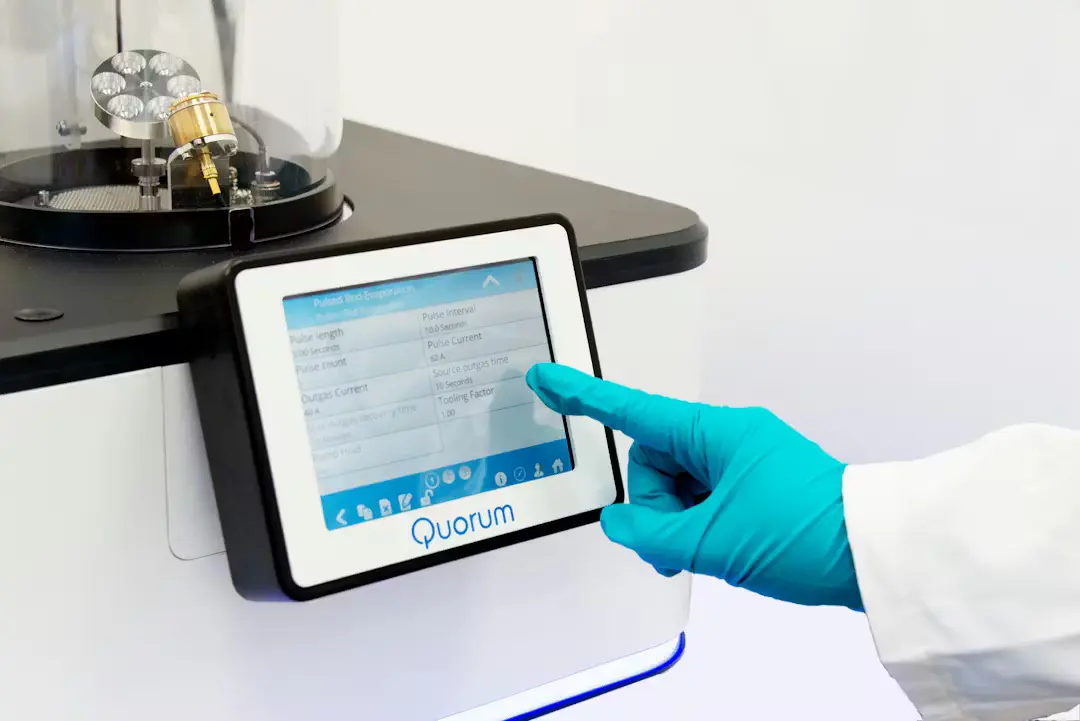
The RotaQ-S is the workhorse sputter coater for most university research labs, government institutes, and pharmaceutical R&D facilities in India. Its 100 mm rotary-tilting stage ensures uniform coating across all sample positions simultaneously — critical when multiple SEM stubs need identical coating thickness. The included quartz crystal film thickness monitor (QCM) measures deposited film in real time and automatically terminates sputtering at your preset thickness — eliminating the inconsistency of time-based coating. Supports gold, gold-palladium, and platinum targets. This is the model recommended for labs doing routine biological, pharmaceutical, food science, or materials science SEM imaging on W-SEM instruments.
| Vacuum system | Rotary pump |
| Ultimate vacuum | ~5×10⁻² mbar |
| Process gas | Argon |
| Stage diameter | 100 mm, rotary-tilting |
| Target materials | Au, Au/Pd, Pt |
| Thickness monitor | QCM standard |
| Carbon coating | Thread evaporation |
| Ideal SEM | W-SEM, LaB₆ |
| Max coating mag | Up to ~50,000× |
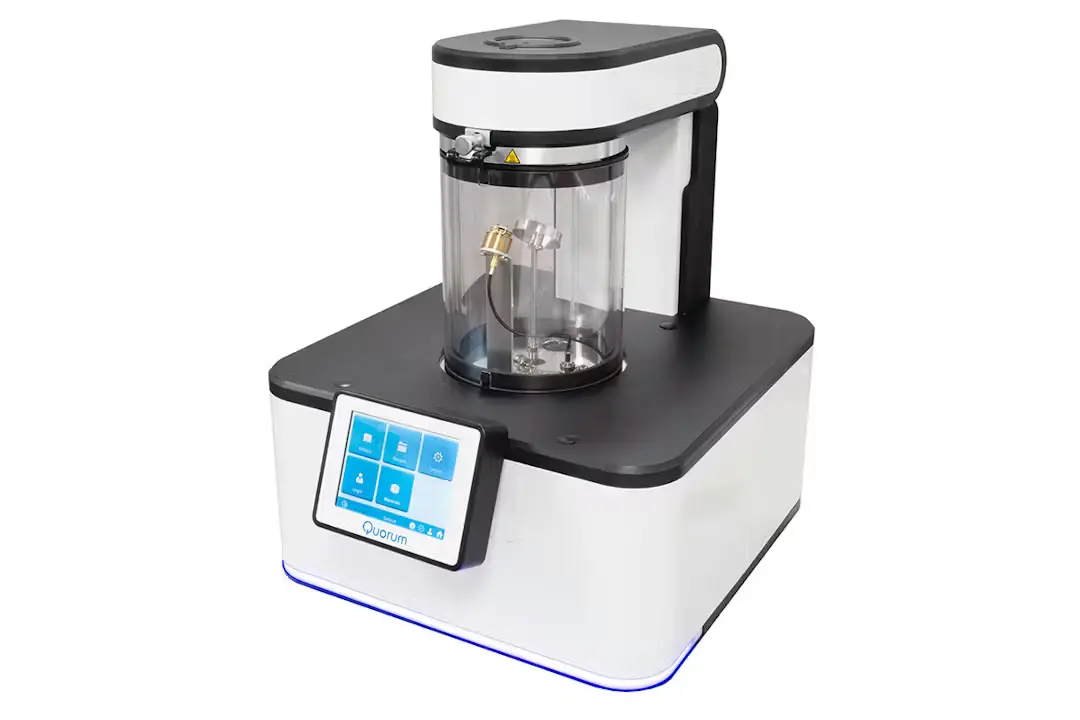
Quorum RotaQ-ES
The RotaQ-ES is the essential upgrade for any lab whose SEM is equipped with an EDS/EDX detector. It combines DC magnetron sputter coating (gold, gold-palladium for morphology imaging) and carbon evaporation (thread and rod, for EDS analysis) in a single integrated instrument — eliminating the need to purchase and operate two separate systems. The switchable head design makes transitioning between sputter and carbon coating straightforward. The 100 mm rotary-tilting stage with QCM monitoring ensures uniform, reproducible films for both coating modes. For Indian materials science, pharma QC, and semiconductor labs performing both SEM imaging and elemental analysis, the RotaQ-ES is the highest-value instrument in the Quorum range.
| Vacuum system | Rotary pump |
| Stage diameter | 100 mm, rotary-tilting |
| Sputter targets | Au, Au/Pd, Pt |
| Carbon source | Thread + rod evaporation |
| Thickness monitor | QCM standard |
| EDS compatible | Yes — carbon mode |
| Ideal SEM | W-SEM + EDS detector |
| Best application | Materials, pharma, geology |
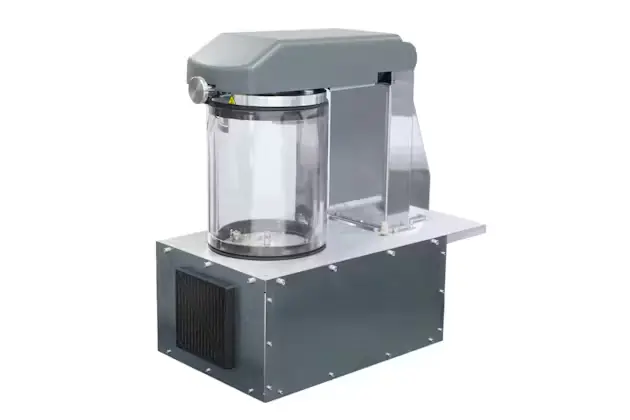
Quorum Q150 GB
The Q150 GB is designed for high-volume, multi-user SEM core facilities — IIT central EM labs, CSIR institutes, hospital pathology departments, pharmaceutical manufacturing QC labs, and industrial failure analysis centres. Its 150 mm rotary stage handles the largest sample batches in the rotary-pump range, coating multiple sample holders simultaneously in a single cycle. The Q150 GB offers the widest target selection of any rotary-pump Quorum coater — gold, platinum, silver, titanium, and carbon rod evaporation — making it adaptable to virtually any SEM or light analytical SEM application. The fully automated coating cycle with dual QCM monitoring ensures reproducibility across operators and shifts. For TEM applications, the Q150 GB's carbon rod evaporation capability prepares support films and carbon replicas.
| Vacuum system | Rotary pump |
| Stage diameter | 150 mm, rotary |
| Target materials | Au, Pt, Ag, Ti, others |
| Carbon source | Thread + rod evaporation |
| Thickness monitor | QCM standard |
| EDS compatible | Yes — carbon mode |
| Sample throughput | High — batch coating |
| Ideal for | Core facilities, CROs, pharma QC |
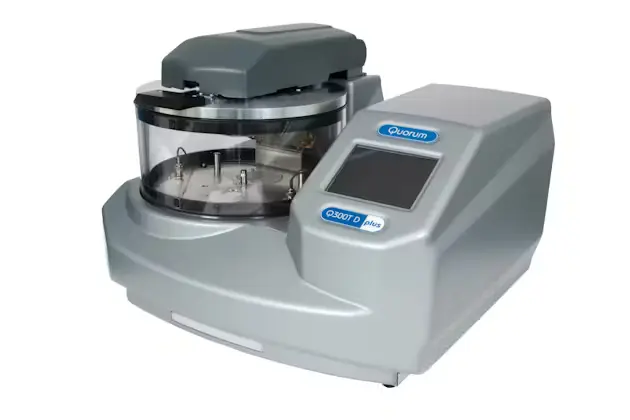
Quorum Q300T-D Plus
The Q300T-D Plus is the reference high-vacuum sputter and carbon coater for India's most demanding electron microscopy facilities. Its dual-pump system — turbomolecular pump backed by a rotary pump — achieves vacuum levels below 10⁻⁵ mbar, enabling platinum, chromium, and iridium coatings with grain sizes under 2 nm. These are invisible at any FE-SEM magnification — essential for high-resolution imaging at 100,000× and above on Zeiss Sigma, JEOL JSM-7800F, or Thermo Fisher Apreo.
Features a 300 mm stage, dual QCM monitors, fully automated coating cycles, and integrated carbon rod evaporation for TEM support films. The dual-target configuration allows rapid switching between sputter and carbon modes without venting. The instrument of choice for IIT, IISc, NCBS, and JNCASR.
Which Sputter Coater Is Right for Your Lab?
Match your laboratory's situation to the recommended Quorum model. These recommendations are based on GBS's experience across hundreds of installations at Indian research institutions, pharmaceutical companies, and industrial facilities.
Pre-Purchase Checklist — Sputter Coater for SEM
Before finalising your Quorum sputter coater purchase, go through this checklist with GBS. These questions ensure the system matches your exact workflow requirements and avoids costly mismatches.
- What SEM instrument model do you coat for — W-SEM, LaB₆, or FE-SEM?
- What is your routine maximum imaging magnification? (<50,000× → rotary; >50,000× → turbo)
- Does your SEM have an EDS/EDX detector? If yes — carbon coating capability is mandatory.
- What are your primary sample types? (biological, pharma, polymer, ceramic, metal, geological)
- What is your maximum sample stub or holder diameter? Check the stage size accommodates it.
- How many samples per week? (<20 → MiniQ-S; 20–80 → RotaQ-S/ES; 80+ → Q150 GB or Q300T-D Plus)
- Do you need reproducible, documented film thickness for publications, QC, or regulatory compliance?
- Is 3-phase power available? (Q300T-D Plus may require specific electrical supply)
- Will multiple operators with varying experience use the system? Consider automation level.
- Do you also need TEM sample preparation? (Consider Q300T-D Plus + glow discharge unit)
- Is procurement through GeM portal, DST/DBT/SERB grant, or institutional PO? GBS handles all documentation.
Buying a Sputter Coater in India — GBS as Your Authorized Partner
As the authorized Quorum Technologies distributor in India, Global Bio Science Solution (GBS) manages the complete procurement process — from import clearance and customs documentation to installation, commissioning, operator training, and annual maintenance. This end-to-end support is a critical differentiator when procuring specialized scientific instruments that require expert installation and ongoing technical support.
Import, Customs & GeM Portal Documentation
All Quorum instruments are imported under the correct HS code with standard IGST treatment. GBS provides complete documentation for GeM portal procurement, institutional purchase orders, and grant-funded acquisitions under DST, DBT, SERB, CSIR, and ICMR schemes. For institutions eligible for customs duty exemption under the scientific instrument import scheme, GBS will advise on Form CT-3, DSIR approval, and supporting documentation. Lead times for standard models: 6–10 weeks from confirmed order.
Installation, Commissioning & Training
All Quorum systems supplied by GBS include on-site installation and operator training at your facility — anywhere in India including Bengaluru, Mumbai, Delhi-NCR, Chennai, Hyderabad, Pune, Kolkata, Ahmedabad, and Chandigarh. A GBS applications engineer will: install and commission the instrument, perform a vacuum performance check and leak test, calibrate the QCM system, coat and image a standard reference sample to verify performance, and provide hands-on training for all laboratory staff in daily operation, target replacement, QCM calibration, argon gas management, and routine maintenance procedures.
Consumables, Spares & After-Sales Service
Sputter targets (gold, gold-palladium, platinum, carbon thread, carbon rods, silver, titanium), argon gas cylinders, viton O-rings, and other consumables are stocked by GBS in Bengaluru and can be shipped next-day to most Indian cities. Annual Preventive Maintenance (PM) visits and corrective maintenance service contracts are available. Ordering a spare target set and key consumables at the time of instrument purchase is strongly recommended to avoid disruption to sample preparation workflows.
Related GBS Products for Complete SEM/TEM Sample Preparation
- HPT-100 Plasma Cleaner — remove hydrocarbon contamination from SEM samples, stubs, and the SEM chamber itself before imaging
- GloQube Plus Glow Discharge — TEM grid hydrophilisation for cryo-EM sample vitrification; essential for cryo-EM labs
- MiniQ GD Glow Discharge — compact entry-level glow discharge unit for TEM grid preparation
- EM Consumables — TEM grids (copper, gold, holey carbon, Quantifoil), SEM stubs, carbon tape, conductive tabs, grid boxes, anti-capillary tweezers
- PicoVision PV-100 Tabletop W-SEM — compact floor-model SEM with 20–300,000× magnification; available with EDS integration
- NuNano AFM Probes — Scout 70, 150, 350 series for atomic force microscopy; supplied alongside SEM systems
Frequently Asked Questions — Sputter Coater for SEM
These questions represent the most common search intents from Indian researchers — informational, comparative, and transactional. Each answer is written for AI engine citation (AEO) and structured with FAQ schema markup.