


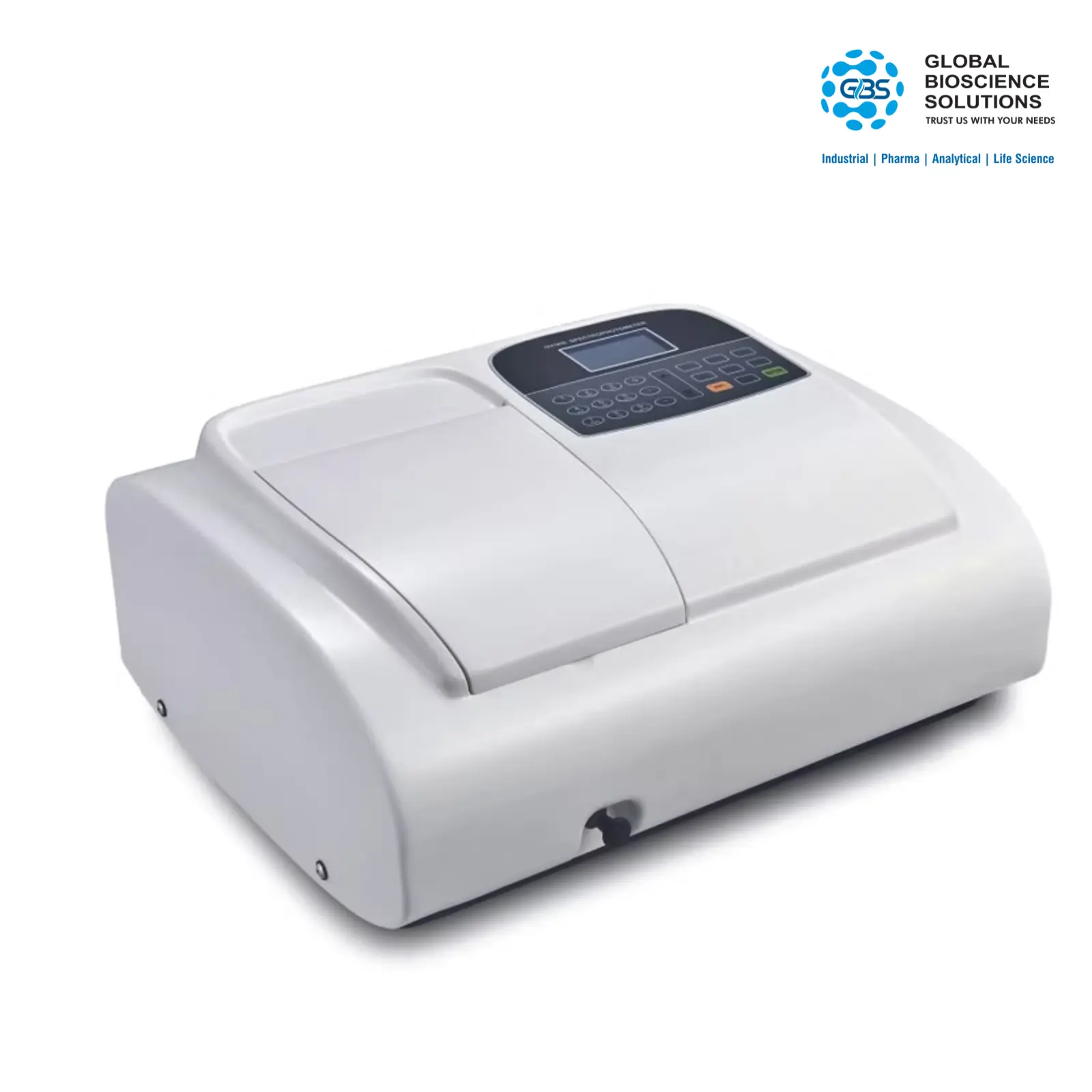
Single Beam Spectrophotometer · Supplied in India
Category: Spectrophotometers · Single Beam
Extended Range Single Beam UV-Vis Spectrophotometer | 190–1100 nm
A high-precision automatic UV-Vis spectrophotometer and laboratory UV-Vis spectrophotometer with an extended 190–1100 nm range, reaching the near-infrared edge for UV, visible and NIR analysis.
Its dual light source and automatic wavelength selection deliver ±0.8 nm wavelength accuracy for pharma, environmental and academic labs. Prefer 190–1000 nm? See the advanced single beam UV-Vis, or the double beam model.
✓ 190–1100 nm range ✓ ±0.8 nm accuracy ✓ Auto wavelength setting
190–1100 nm Extended Range
±0.8 nm Accuracy
1200 Lines/mm Grating
Dual Light Source
Automatic Wavelength
Extended Range UV-Vis at a Glance
This single beam UV-Vis spectrophotometer, supplied in India by Global Bioscience Solutions (Bengaluru), measures absorbance and transmittance from 190 to 1100 nm with a 2 nm bandwidth, ±0.8 nm wavelength accuracy and ±0.5% T photometric accuracy. A deuterium lamp covers UV and a tungsten halogen lamp covers visible and near-infrared light. It takes standard 10 mm quartz cuvettes, has an LCD with USB/PC interface, and is used for pharma testing, life science assays, water quality testing and teaching labs.
Technical Specifications
| Optical System | Single beam, 1200 lines/mm holographic grating |
| Wavelength Range | 190–1100 nm |
| Spectral Bandwidth | 2 nm |
| Wavelength Accuracy | ±0.8 nm |
| Photometric Accuracy | ±0.5% T |
| Light Source | Deuterium lamp (UV) and tungsten halogen lamp (visible/NIR) |
| Sample Compartment | Standard 10 mm path length, quartz cuvette compatible |
| Display and Interface | LCD display, USB and PC interface |
| Operation | Microprocessor controlled, automatic wavelength setting |
| Supplier | Global Bioscience Solutions, Bengaluru, India |
Extended Range vs Advanced Single Beam vs Double Beam
| Feature | Extended Range (this model) | Advanced Single Beam | Double Beam |
|---|---|---|---|
| Wavelength range | 190–1100 nm | 190–1000 nm | 190–1100 nm |
| Bandwidth | 2 nm | 2 nm | 1 nm |
| Wavelength accuracy | ±0.8 nm | ±1.0 nm | ±0.3 nm |
| Best for | Routine work needing NIR edge | Economical routine analysis | Research, low-drift work |
Key Features of the Extended Range Spectrophotometer
Built for precision in modern chemistry, pharma and life science laboratories.
Extended 190–1100 nm Wavelength Range
Pushes the spectrum from 190 nm to 1100 nm, capturing data at the near-infrared edge for specialised assays beyond the usual 1000 nm limit.±0.8 nm Wavelength Accuracy
With a 2 nm spectral bandwidth and 1200 lines/mm holographic grating, it gives dependable data for protein and nucleic acid measurements.Automatic Wavelength Selection
The instrument sets the wavelength automatically, removing manual dial errors and speeding up measurements.Dual Light Source
A deuterium lamp covers UV and a tungsten halogen lamp covers visible and NIR, for consistent photometric accuracy.
How to Measure Absorbance with a UV-Vis Spectrophotometer
- Warm up and select wavelength: Switch on, let the lamps stabilise, and choose the analytical wavelength (set automatically).
- Blank the instrument: Fill a clean quartz cuvette with the reference solution and zero the absorbance.
- Insert the sample: Place a 10 mm cuvette containing your sample in the compartment.
- Read the result: Record absorbance or %T on the LCD, or send data to a PC over USB.
Industry Applications and Analytical Uses
From academic research to industrial quality control, this UV-Vis spectrophotometer for laboratories scales to your needs. For nucleic acid work on tiny volumes see the EzDrop 1000.
Pharmaceutical Testing
Quantitative analysis, drug assays and ingredient purity verification in pharma QC labs.Life Sciences and Biochemistry
Protein and nucleic acid estimation (cuvette volumes) and enzyme kinetics studies.Environmental and Water Quality Testing
Water quality testing, wastewater and environmental analysis protocols.Academic and Teaching Laboratories
Routine absorbance work in college and university laboratories.
Why Buy from Global Bioscience Solutions
We are a Bengaluru-based laboratory equipment supplier in India. Read our guide to scientific instrument suppliers in India or browse all spectrophotometers.
Installation, Training and AMC
Setup, user training, warranty and annual maintenance support.Tenders and Institutional Purchases
Quotations for universities, government labs and pharma companies, including GeM requirements.
Related Products
Frequently Asked Questions
What is the advantage of the extended 190–1100 nm range?
The extended range lets you analyse further into the near-infrared edge, useful for specific quantitative, chemical and specialised pharmaceutical assays that go beyond a 1000 nm limit.
What ensures the wavelength precision of this instrument?
A 1200 lines/mm holographic grating and automatic wavelength selection give ±0.8 nm wavelength accuracy and avoid manual setting errors.
What light sources does this spectrophotometer use?
A deuterium lamp for the ultraviolet range and a tungsten halogen lamp for the visible and near-infrared range.
What is the difference between this model and the 190–1000 nm model?
This model extends the range to 1100 nm and has ±0.8 nm wavelength accuracy, against 190–1000 nm and ±1.0 nm on our advanced single beam model. Both use a 2 nm bandwidth and a 10 mm cuvette compartment.
What is the difference between single beam and double beam UV-Vis?
A single beam instrument uses one light path, so blank and sample are measured in turn. A double beam instrument monitors sample and reference together, reducing drift. Single beam is simpler and more economical for routine work.
Is it compatible with standard cuvettes?
Yes. It accepts standard 10 mm path length cuvettes, including quartz cuvettes for UV measurements.
Can I measure DNA, RNA or protein with it?
Yes, in cuvette volumes, for example A260 for nucleic acids and A280 or colorimetric assays for protein. For 1–2 µL samples, see the EzDrop 1000 or EzDrop 1000C.
Is it suitable for academic and teaching labs?
Yes. The simple digital interface and robust build suit college and university teaching labs while still supporting research and QC work.
Which laboratories use this spectrophotometer?
Pharma QC labs, water and environmental testing labs, hospital and contract testing labs, and college and university laboratories.
What is the UV-Vis single beam spectrophotometer price in India?
Price depends on configuration and quantity. Submit a quotation request and we will send a proposal covering instrument cost, delivery and installation across India.
Do you offer installation, training and AMC?
Yes. Global Bioscience Solutions provides installation, user training, warranty and AMC support across India.
Can this be supplied for tenders and institutional purchases?
Yes. We supply universities, government research facilities and pharma companies and provide institutional quotations on request.