


The Blue Ray EzCube is a benchtop triple-channel fluorometer that quantifies dsDNA, RNA, proteins, and cfDNA with up to 10,000× greater sensitivity than a NanoDrop UV spectrophotometer. Using three independent LED channels (blue 480nm, green 535nm, red 630nm) with dye-based assays, it detects dsDNA from as little as 0.1 pg/µL in a 1µL sample loaded in a standard 0.5mL PCR tube. The 7-inch touchscreen, built-in reagent calculator, and USB data export make it the most user-friendly fluorometric quantification instrument available in India. Available from GBS Bengaluru — the authorized Blue Ray Biotech India distributor: +91 97436 20456.
Blue · Green · Red
in 0.5mL PCR tube
than NanoDrop (dsDNA)
with reagent calculator
Why You Need a Fluorometer — Not Just a NanoDrop
If your lab has a NanoDrop or micro-volume spectrophotometer for DNA and RNA quantification, you already have a powerful and versatile tool for quick sample checking. But if you're running any of the following workflows — NGS library preparation, low-yield RNA extraction, cfDNA from liquid biopsies, or single-cell genomics — your NanoDrop is giving you inaccurate concentrations, and those inaccurate concentrations are costing you sequencing runs.
Here's why: UV spectrophotometry at 260nm measures total absorbance of everything that absorbs at 260nm — and that includes free nucleotides, degraded RNA fragments, protein contaminants, and other UV-absorbing impurities in your sample. If your A260/280 ratio looks fine but your sample has significant RNA contamination in a DNA prep, or degraded fragments in an RNA prep, the NanoDrop will give you an overestimate of your usable nucleic acid concentration. When you then use that concentration to normalise a sequencing library, you're loading too little DNA — and you get a failed or undersequenced library run.
A fluorometer eliminates this problem entirely. Fluorescence-based quantification uses dyes that only emit fluorescence when bound to the specific target molecule — a dsDNA-specific dye (like PicoGreen or the EzQuant dsDNA reagent) emits fluorescence proportional only to intact double-stranded DNA, completely ignoring single-stranded DNA, RNA, protein, and free nucleotides in the same sample. The result is the concentration of the molecule you actually want to sequence, not the total UV-absorbing material in your tube.
A common scenario in Indian genomics and sequencing labs: a researcher quantifies an NGS library on the NanoDrop, normalises to the target concentration (e.g., 10 nM), and submits for sequencing. The sequencing run returns with 30–50% lower coverage than expected. The cause: the NanoDrop over-estimated the library concentration because it included free adapters, primer dimers, and adapter-ligated fragments — none of which are the useful library. A fluorometer with a dsDNA high-sensitivity assay would have given the correct concentration of intact, size-selected library fragments — and the sequencing run would have returned the expected coverage at the correct cost.
Blue Ray EzCube Fluorometer — Complete Product Guide
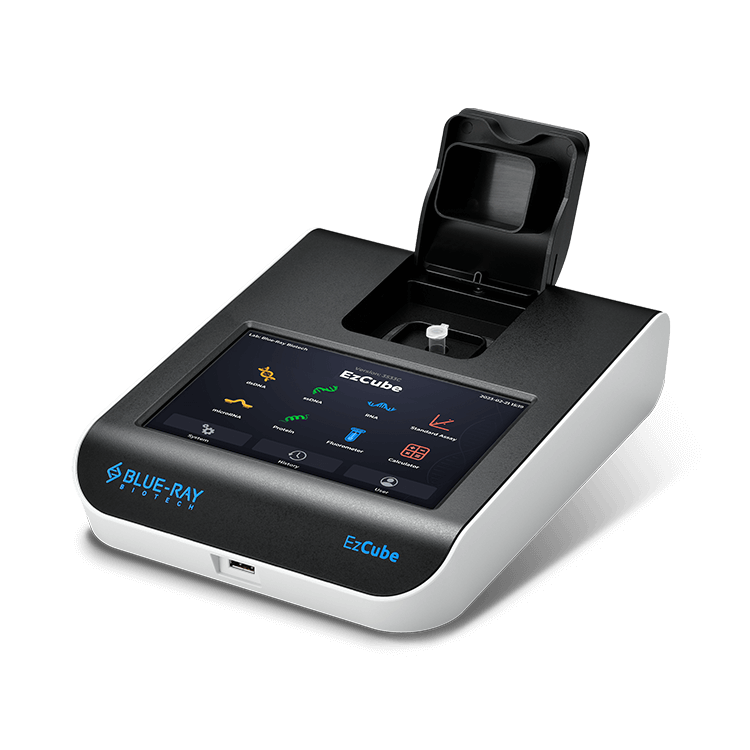
Blue Ray EzCube Triple Channel Fluorometer
The EzCube is a precision benchtop fluorometer built for demanding molecular biology quantification workflows. Three independent LED channels — blue, green, and red — cover the full spectrum of fluorometric nucleic acid and protein assays used in modern labs. With sample volumes from just 1µL measured in standard 0.5mL thin-wall PCR tubes, it conserves precious samples while delivering quantification accuracy 10–10,000× greater than UV spectrophotometry for critical applications. The 7-inch colour touchscreen with built-in reagent calculator walks users through protocol setup, calculating how much sample and working solution to combine for each specific assay — eliminating calculation errors and reducing hands-on time. As an open-system instrument, the EzCube works with Blue Ray's own EzQuant assay kits as well as a broad range of compatible fluorometric quantification reagents.
The Three Fluorescent Channels — What Each One Does
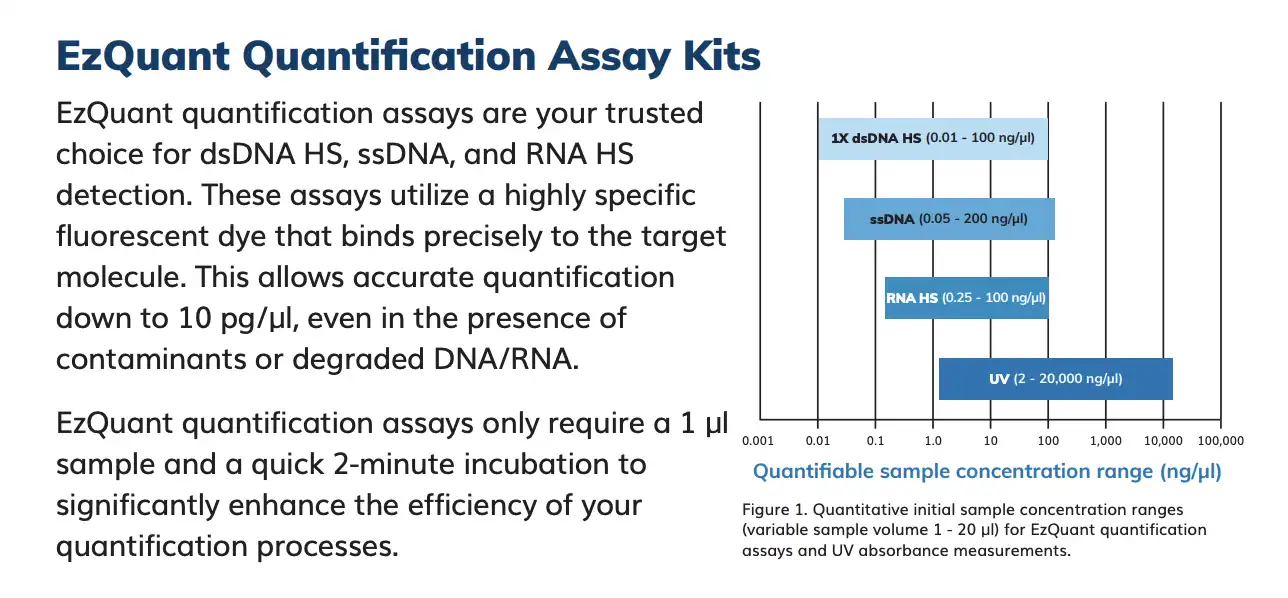
The EzCube's triple-channel design is its defining technical advantage. Each LED and corresponding emission filter is independently optimised for a specific set of fluorometric assays, giving a single instrument complete coverage of all standard nucleic acid and protein quantification workflows in a molecular biology lab.
Blue Channel
Green Channel
Red Channel
EzCube Fluorometer vs NanoDrop Spectrophotometer — Head-to-Head
This is the most important technical comparison for Indian molecular biology labs deciding whether to add fluorometric quantification. The choice is not either/or — both instruments have a role — but understanding where each excels determines when you must use a fluorometer.
| Criterion | EzCube Fluorometer | NanoDrop / EzDrop (UV Spectrophotometer) |
|---|---|---|
| Detection principle | Target-specific dye fluorescence | Total UV absorbance at 260nm |
| dsDNA detection limit | 0.1 pg/µL (HS assay) | ~2 ng/µL minimum |
| Sensitivity advantage | 10,000× more sensitive (HS mode) | Baseline reference |
| Selectivity | Detects only target molecule (dsDNA, RNA, or protein separately) | Detects ALL UV-absorbing molecules — cannot distinguish DNA from RNA |
| Effect of RNA in DNA sample | Ignored — dsDNA dye does not bind RNA | RNA contamination overestimates DNA concentration |
| Effect of protein contamination | Ignored by nucleic acid assays | Protein at 280nm inflates apparent purity ratio |
| NGS library quantification | Required — accurate dsDNA-specific measurement | Not recommended — adapters and free nucleotides inflate reading |
| cfDNA quantification | Red channel, 0.1 pg/µL sensitivity | Not suitable — concentration too low for UV detection |
| Sample volume | 1–20 µL (in PCR tube assay solution) | 1–2 µL directly on pedestal — no tube needed |
| Assay reagent required | Yes — fluorescent dye assay kit | No — direct measurement, no reagent |
| Time per measurement | ~3–5 minutes (including assay setup) | ~15–30 seconds |
| Purity ratios (A260/280, A260/230) | ✗ Not available | ✓ Yes — full spectral data |
| Protein quantification | ✓ Green channel, fluorometric | ✓ A280, BCA/Bradford by absorbance |
| Best for | NGS, low-conc samples, cfDNA, accurate library normalisation | Quick QC check, purity assessment, routine lab use |
Most well-equipped molecular biology labs use both instruments for different steps. The EzDrop 1000 spectrophotometer for quick post-extraction purity checks (A260/280, A260/230) and rough concentration screening. The EzCube fluorometer for accurate quantification before critical downstream steps: NGS library normalisation, qPCR standard curve preparation, cfDNA analysis, and any assay where knowing the exact concentration of your specific target molecule determines success or failure.
EzCube in the NGS Library Preparation Workflow
Next-Generation Sequencing library preparation is the most demanding quantification workflow in molecular biology — and the one where fluorometric quantification has the highest impact on outcomes. Here is how the EzCube fits into a standard NGS library prep workflow for Indian genomics labs.
Genomic DNA input quantification — dsDNA Broad Range assay
Before starting library prep, accurate starting material quantification is essential. The EzCube with dsDNA Broad Range assay (2 ng/µL–15 µg/µL, Blue channel) gives the true gDNA concentration — excluding RNA carryover from the extraction that would cause over-input and increase adapter-dimer formation. Combine 1µL sample with 199µL EzQuant dsDNA BR working solution in a 0.5mL thin-wall PCR tube. Read in the EzCube. Result in under 5 minutes.
Post-fragmentation QC — dsDNA High Sensitivity assay
After acoustic or enzymatic fragmentation, fragment concentrations often drop into the 1–10 ng/µL range — below reliable NanoDrop detection. The EzCube dsDNA High Sensitivity assay (0.1 pg/µL–100 ng/µL, Blue channel) accurately quantifies the fragmented material, ensuring the correct mass is taken into adapter ligation. This step is especially critical for FFPE-derived DNA, ancient DNA, and cell-free DNA where starting material is severely limited.
Library quantification before sequencer loading — dsDNA HS assay
This is the most critical fluorometry step in the entire workflow. The final library — after adapter ligation, PCR amplification (if applicable), and size selection — must be accurately quantified before loading onto the Illumina, MGI, or Oxford Nanopore sequencer. The EzCube dsDNA HS assay gives the concentration of adapter-ligated double-stranded library fragments, excluding free adapters, primer dimers, and any residual ssDNA carryover. Accurate library normalisation prevents cluster density failures, unbalanced multiplexing, and wasted sequencing capacity.
RNA quantification for transcriptomics — RNA HS assay
For RNA-seq library preparation, input RNA concentration and integrity are both critical. The EzCube RNA High Sensitivity assay (5 pg/µL–100 ng/µL, Green channel) accurately quantifies total RNA or rRNA-depleted fractions before reverse transcription. Unlike the NanoDrop, the RNA assay only detects intact RNA — degraded RNA fragments below the assay's dye binding threshold are not counted, giving a better indicator of usable transcriptomic material.
cfDNA quantification from plasma — Red channel
Cell-free DNA (cfDNA) from liquid biopsy plasma samples exists at picomolar concentrations — typically 1–10 ng/mL of plasma — far below the NanoDrop's reliable detection threshold. The EzCube's Red channel with cfDNA-specific assay detects down to 0.1 pg/µL, enabling accurate cfDNA quantification from 1mL plasma samples for liquid biopsy, prenatal testing (NIPT), and circulating tumour DNA monitoring applications.
Applications — Where the EzCube Fluorometer Excels
NGS Library Quantification
The primary use case. Accurate dsDNA-specific quantification of Illumina, MGI, and Nanopore libraries before sequencing. Prevents cluster density failures and wasted runs.
Low-Concentration DNA
FFPE-extracted DNA, ancient DNA, forensic samples, ChIP-seq inputs — all at concentrations below reliable NanoDrop detection. dsDNA HS assay detects to 0.1 pg/µL.
cfDNA / Liquid Biopsy
Cell-free DNA from plasma for NIPT, ctDNA monitoring, and liquid biopsy applications. Red channel provides specificity and sensitivity at picomolar levels.
RNA Quantification
Total RNA, mRNA, rRNA-depleted RNA, and microRNA quantification for RNA-seq, RT-qPCR, and RNA interference experiments. High sensitivity down to 5 pg/µL.
Single-Cell Genomics
Input cell DNA and library quantification for single-cell RNA-seq and ATAC-seq — where sample amounts are inherently tiny and every nanogram counts.
Protein Quantification
High-sensitivity protein assay (ProteinGreen, Green channel) for samples too dilute for Bradford or BCA colorimetric assays, or where colorimetric assay interference is a concern.
Therapeutic Nucleic Acids
siRNA, antisense oligonucleotides, mRNA therapeutics, and plasmid DNA quantification for gene therapy and vaccine development at Indian biotech companies.
Plant & Environmental DNA
Metagenomics samples, environmental DNA (eDNA), and plant genomic DNA containing high levels of PCR-inhibiting polysaccharides and phenolics that inflate UV absorbance.
Plasmid DNA QC
Accurate plasmid DNA quantification excluding RNA carryover — critical for transfection efficiency in cell biology and for therapeutic-grade plasmid characterisation.
EzCube Fluorometer in India — GBS as Your Authorized Partner
As the authorized Blue Ray Biotech distributor in India, GBS supplies the EzCube fluorometer along with EzQuant assay kits to research institutions, pharmaceutical companies, genomics labs, CROs, and biotech companies across India. Our team provides installation, product training, and ongoing consumables supply from our Bengaluru warehouse.
EzQuant Assay Kits — Purpose-Built for the EzCube
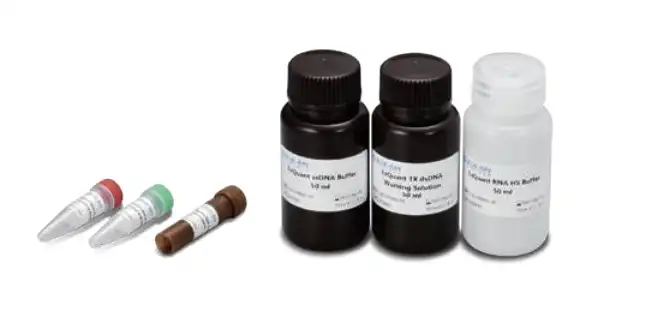
Blue Ray Biotech's EzQuant assay kit range is specifically optimised for the EzCube fluorometer, with protocols validated to the instrument's LED specifications. Available kits include EzQuant dsDNA HS Kit, EzQuant dsDNA BR Kit, EzQuant RNA HS Kit, EzQuant RNA BR Kit, and EzQuant Protein Kit. All kits are available from GBS India with regular stock maintained in Bengaluru for next-day shipping to most Indian cities. The EzCube's open-system design also supports third-party quantification kits — contact GBS for specific compatibility queries.
Complete Blue Ray Biotech Molecular Biology Lab Setup from GBS
- EzCube Fluorometer — triple-channel high-sensitivity quantification (this instrument)
- EzDrop 1000 Spectrophotometer — quick purity check and routine quantification. Use alongside EzCube for a complete quantification workflow
- TurboCycler 2 — 96-well gradient PCR thermal cycler with 5.5°C/sec ramp, Wi-Fi TurboApp monitoring
- TurboCycler 3 — triple-block 144-well PCR thermal cycler for multi-user labs and high throughput
- EzScope 101 — incubator-based live cell imaging system for real-time proliferation, migration, and apoptosis monitoring
- EzDecap Tube Handler — automated tube decapping for high-throughput sample processing
Frequently Asked Questions — EzCube Fluorometer India 2026
Structured with FAQPage JSON-LD schema for AI search engines (ChatGPT, Perplexity, Gemini, Claude) and Google Featured Snippets.