


Plasma cleaning uses a low-pressure RF plasma (oxygen, argon, or mixed gas) to chemically remove hydrocarbon contamination from TEM and SEM samples, grids, and specimen holders before imaging. Hydrocarbons crack under the electron beam, depositing amorphous carbon that obscures surface features, distorts EDS spectra, and progressively contaminates the microscope column. The Quorum HPT-100 (benchtop RF plasma cleaner, 0–100W, 100mm chamber) is the solution for SEM and TEM sample cleaning. The HPT-100 TEM variant adds front-feed TEM holder compatibility. The GloQube Plus is a complementary glow discharge system for TEM grid surface activation. All are available in India through GBS: +91 97436 20456.
Hydrocarbon Contamination — The Hidden Enemy of Electron Microscopy
Every sample you place in a transmission electron microscope or scanning electron microscope carries invisible contamination — a thin layer of adsorbed organic molecules from skin contact, solvents, ambient air, storage plastics, pump oil backstreaming, and laboratory bench surfaces. These molecules are largely harmless and invisible under normal conditions, but the moment the focused electron beam strikes the sample surface, something destructive happens.
The high-energy electron beam cracks hydrocarbon molecules on and around the beam impact zone, breaking them into reactive radical species. The volatile components are pumped away, but the non-volatile heavy carbon fragments polymerise and deposit as a growing layer of amorphous carbon — directly at the beam position. This process, known as beam-induced carbon deposition or contamination growth, happens continuously during imaging and has cascading effects on data quality.
What Happens When You Don't Plasma Clean
The consequences of hydrocarbon contamination in electron microscopy appear at multiple levels, each affecting different aspects of data quality:
- Carbon deposition during imaging — the beam-induced carbon layer grows at the scan position, physically obscuring surface features and changing sample topography in real time. In TEM, this means structural detail in your sample is progressively buried under an amorphous carbon dome.
- Sample drift — the charge redistribution caused by carbonaceous buildup generates local electric fields that cause the sample to drift under the beam, making high-magnification imaging unstable and preventing precise positioning.
- Reduced signal-to-noise ratio in SEM — carbon deposits absorb secondary electrons before they reach the detector, reducing signal intensity and image contrast — especially damaging for low-signal samples like biological tissue.
- Erroneous carbon peaks in EDS/EDX — beam-deposited carbon adds a false carbon signal to your EDS spectrum. If you're quantifying carbon content in your sample — nanocomposites, organic materials, carbon-containing alloys — the contamination peak makes accurate quantification impossible.
- Column contamination and increased maintenance frequency — volatile hydrocarbon fragments travel through the microscope column, depositing on apertures, pole pieces, and detectors. Over weeks of contaminated operation, resolution degrades, and the microscope requires more frequent bake-out and cleaning cycles — costly in instrument downtime and service engineer fees.
- TEM EELS baseline corruption — for labs using electron energy loss spectroscopy, the carbon edge at 284 eV is a critical feature. Beam-induced carbon contamination shifts and broadens this edge, corrupting EELS data and making fine structure analysis unreliable.
A single plasma cleaning cycle costs approximately 2–5 minutes of instrument time. A contaminated TEM or SEM session costs: lost imaging time on a ₹3–15 crore instrument, repeated sessions to re-acquire clean data, accelerated column cleaning schedules, and in severe cases, aperture replacement. For IIT and CSIR facilities where instrument bookings are weeks in advance, repeat sessions carry a significant opportunity cost. Plasma cleaning is an investment in data quality and instrument longevity — not an optional step.
How Plasma Cleaning Works — The RF Plasma Process
Plasma cleaning uses a low-pressure radio frequency (RF) plasma to generate highly reactive atomic and radical species that chemically attack and remove hydrocarbon contamination. The process is fundamentally different from simple physical sputtering (used in sputter coaters) — it is a chemical process that converts organic contaminants to gaseous products that are removed by the vacuum pump, leaving no residue.
Oxygen Plasma vs Argon Plasma — Choosing the Right Gas
The choice of plasma gas determines the cleaning mechanism, aggressiveness, and suitability for different sample types. Understanding this is essential for getting optimal results without damaging delicate samples.
| Gas | Mechanism | Best For | Avoid For | Typical Power | Typical Time |
|---|---|---|---|---|---|
| Oxygen (O₂) | Chemical oxidation — O radicals react with C, H to form CO₂ and H₂O | Bulk hydrocarbon removal, SEM specimens, TEM holders, plasma ashing | Oxidation-sensitive metals (Al, Fe, Cu), some biological TEM samples | 30–100W | 30 sec – 10 min |
| Argon (Ar) | Physical bombardment — Ar⁺ ions physically sputter contaminants from surface | Gentle surface activation, oxidation-sensitive samples, metallic specimens | Bulk carbon deposits (slow process), photoresist removal | 10–50W | 30 sec – 5 min |
| O₂/Ar Mix (80:20) | Combined chemical oxidation + physical bombardment | Most routine SEM and TEM cleaning — best general-purpose recipe | Oxidation-sensitive surfaces | 30–70W | 30 sec – 3 min |
| Air | Primarily O₂ oxidation (20% O₂ in air) | General cleaning where separate gas cylinders are not available | Precision work requiring controlled gas composition | 50–100W | 1–5 min |
Step-by-Step Plasma Cleaning Protocol for TEM and SEM
Prepare samples and load the HPT-100 chamber
For SEM: place mounted stubs on the glass tray or drawer. For TEM grids in grid boxes: place the open grid box or individual grids on the tray. For TEM holders: use the standard chamber (HPT-100) or the front-feed port (HPT-100 TEM) to insert the holder without removing the grid from its tip. Ensure the chamber door is fully closed and the O-ring is clean and undamaged.
Select cleaning gas and set flow rates
For routine SEM specimen cleaning: O₂/Ar mix (80:20) at 20–40 sccm total flow. For TEM holder cleaning: O₂/Ar at 30–50 sccm. For gentle surface activation of TEM grids before aqueous sample deposition: Ar only at 15–25 sccm, low power. Use the HPT-100's stored recipe function for frequently-run protocols — eliminates operator-to-operator variation and ensures reproducible results across a multi-user lab.
Set RF power and process time
For SEM specimen cleaning (biological, polymer, pharma): 30–50W for 45–90 seconds. For SEM metal alloy specimens: 20–40W for 30–60 seconds. For TEM holder cleaning: 40–70W for 60–120 seconds. For TEM grid surface activation (before sample deposition, not full contamination removal): 10–25W for 20–45 seconds. For aggressive plasma ashing (bulk carbon, photoresist): 80–100W for 2–15 minutes. Set time on the 5.7-inch touchscreen — the system auto-stops at completion.
Initiate pump-down — Pirani gauge confirmation
The rotary pump evacuates the stainless steel chamber. The HPT-100's integrated Pirani vacuum gauge monitors pressure in real time. The system will only ignite the plasma when vacuum has reached the correct operating level — this interlock prevents plasma ignition at incorrect pressure, which would produce ineffective cleaning or excessive heating. The Pirani reading is displayed continuously on the touchscreen throughout the process.
Run cleaning cycle, vent, and transfer to microscope
The RF generator ignites the plasma automatically at the preset power level. The plasma is visible as a coloured glow through the chamber viewport. After the set time, the system extinguishes plasma, closes gas valves, and vents the chamber. Transfer samples to the electron microscope within 30–60 minutes of cleaning for maximum benefit — atmospheric hydrocarbons begin re-adsorbing to the clean surface immediately. Storage in a clean, covered container or a low-humidity environment extends the effective clean window.
Quorum HPT-100 — Benchtop Plasma Cleaner for SEM & TEM
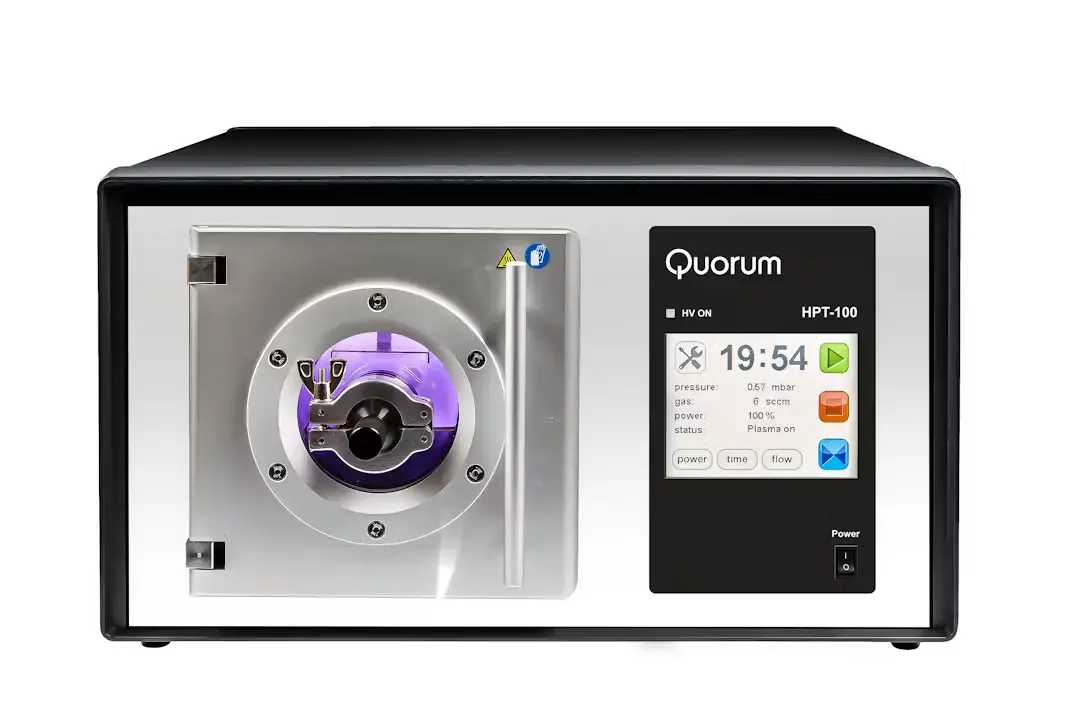
The Quorum HPT-100 is the standard benchtop RF plasma cleaner for electron microscopy sample preparation — a compact, precise, and versatile instrument designed for daily use in multi-user SEM and TEM facilities. Available in India through GBS as the authorized Quorum distributor.
Quorum HPT-100
A versatile, compact benchtop RF plasma cleaner and asher for routine cleaning of SEM and TEM specimens, holders, and grids. Microprocessor-controlled with variable power, dual gas inlets, Pirani vacuum monitoring, recipe storage, and a full-colour touchscreen — designed for precise, reproducible plasma cleaning in multi-user EM facilities.
HPT-100 Key Features Explained
0–100W Variable RF Power — From Gentle Activation to Aggressive Ashing
The 40 kHz RF generator delivers fully variable power from 0 to 100W, with an optional 200W upgrade for high-power plasma ashing applications. This wide power range is essential because different applications demand dramatically different plasma intensities. At low power (5–20W), the plasma gently activates surfaces — increasing surface energy and wettability — without damaging beam-sensitive biological or polymer samples. At mid power (30–70W), routine hydrocarbon removal from SEM specimens and TEM holders is completed in 30–120 seconds. At high power (70–100W), aggressive plasma ashing rapidly removes photoresist, thick carbon contamination, and organic residues from semiconductor substrates or heavily contaminated holders.
Dual Mass Flow Controlled Gas Inlets
Two independent mass flow controlled (MFC) gas inlets allow precise control of O₂ and Ar flow rates independently — critical for running mixed gas recipes at exact ratios. The MFC system maintains consistent gas flow regardless of cylinder pressure variations, ensuring reproducible plasma conditions from run to run. Gas selection and flow rates are set digitally on the touchscreen and stored with the recipe.
Pirani Vacuum Gauge Interlock
The integrated Pirani vacuum gauge continuously monitors chamber pressure. The system will not ignite plasma unless the chamber pressure is within the correct operating range — a safety and quality interlock that prevents failed cleaning runs, protects samples from high-pressure plasma damage, and ensures every cleaning cycle runs at the intended vacuum level. The current vacuum reading is displayed on the touchscreen throughout the process.
Recipe Storage for Multi-User Consistency
The HPT-100 stores multiple process recipes, each with a unique name, power, gas flow, time, and gas composition. For facilities where multiple operators clean different sample types — biological TEM at low power, semiconductor SEM at high power, holder ashing — recipe storage eliminates the risk of incorrect parameter entry and ensures consistency regardless of which lab member runs the instrument.
HPT-100 Applications in Indian EM Labs
- SEM specimen cleaning — remove adsorbed hydrocarbons from biological, pharmaceutical, polymer, and materials science samples before SEM imaging. Reduces beam-induced carbon deposition during long imaging sessions and high-magnification work.
- SEM stage and stub cleaning — plasma clean SEM stubs, stages, and stub adapters to remove cross-contamination from previous samples. Essential in multi-user SEM facilities where biological and inorganic samples share the same specimen holders.
- TEM specimen holder cleaning — remove organic contamination from TEM holder tips, grids, and the surrounding holder surfaces before loading. Standard practice at IIT, IISc, and NCBS TEM facilities to maintain column cleanliness.
- TEM grid surface activation — at low power (10–20W, Ar plasma, 20–30 seconds), the HPT-100 can activate carbon-coated TEM grids to improve aqueous sample wettability before staining or particle deposition. For precision TEM grid activation workflows, the GloQube Plus is the dedicated instrument — see below.
- Plasma ashing — remove photoresist, thick organic layers, or biological tissue from semiconductor or materials specimens using high-power O₂ plasma. Used in failure analysis and microelectronics research.
- Surface modification for adhesion — plasma treatment increases surface energy of polymers, glass, and silicon substrates, improving adhesive bonding, coating adhesion, and antibody attachment for biofunctionalization workflows.
Quorum HPT-100 TEM — Front-Feed Plasma Cleaner for TEM Workflows
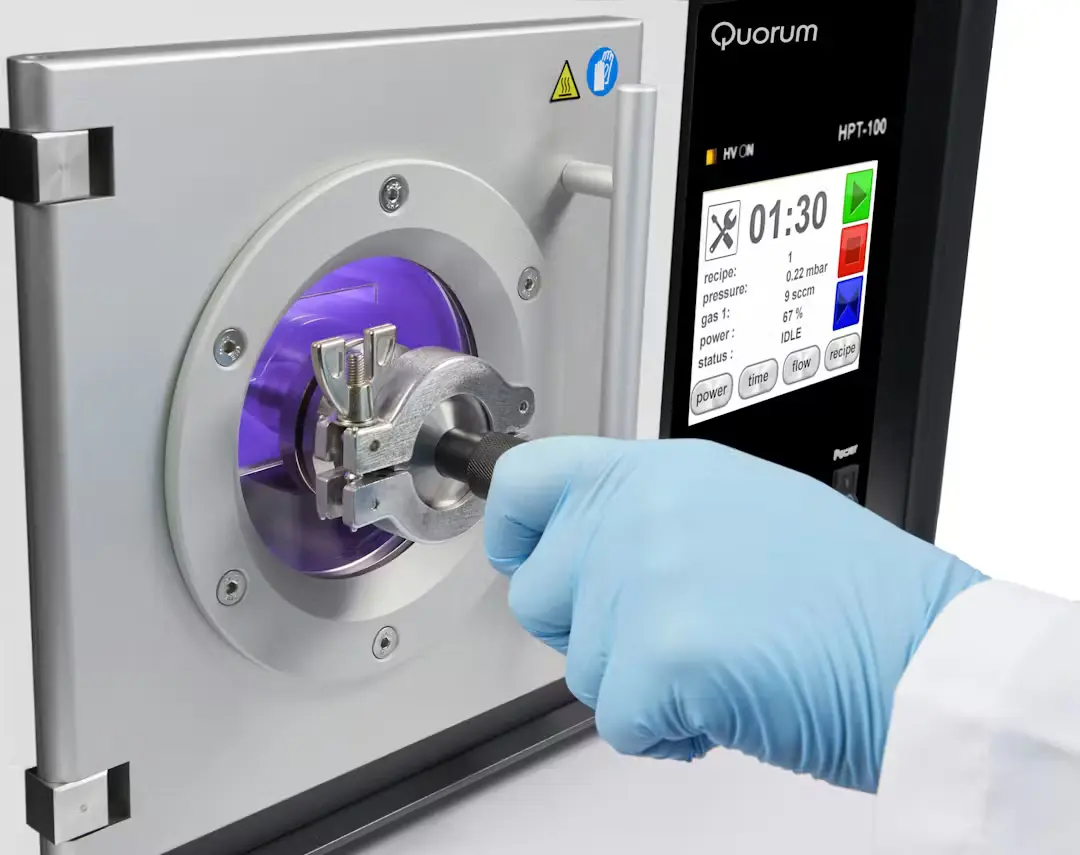
The HPT-100 TEM is the specialized variant of the HPT-100, specifically configured for TEM and cryo-EM workflows where the TEM specimen holder must be plasma cleaned with the grid already mounted — without removing and re-handling the grid. This is critical in cryo-EM workflows and for biological TEM where re-handling a mounted, stained, or frozen grid risks irreversible damage.
Quorum HPT-100 TEM
RF plasma cleaner configured for direct TEM holder insertion via a front-feed port. The standard TEM holder tip (with mounted grid) enters the plasma zone without opening a chamber door — minimizing handling, reducing contamination risk, and enabling cleaning immediately before TEM or cryo-EM session start.
| Holder compatibility | Standard TEM holders, all major brands |
| Plasma power | 0–100W RF @ 40 kHz |
| Chamber | 100mm SS, front-feed port |
| Gas inlets | O₂ + Ar (MFC controlled) |
| Key advantage | No grid removal — clean in situ |
| Ideal for | TEM, cryo-EM, EELS, EDS-TEM |
Quorum HPT-100
The standard HPT-100 with 100mm stainless steel chamber for bulk SEM specimen cleaning, TEM holder batches, and surface ashing. Accepts multiple SEM stubs or a stack of grid boxes simultaneously. Preferred for high-throughput multi-sample workflows where individual holder insertion is not required.
| Chamber loading | Drawer or glass tray — batch mode |
| Plasma power | 0–100W RF (200W optional) |
| Chamber | 100mm Ø × 280mm SS |
| Gas inlets | O₂ + Ar (MFC controlled) |
| Key advantage | High throughput, batch cleaning |
| Ideal for | SEM labs, multi-sample facilities |
When to Use HPT-100 vs HPT-100 TEM — Key Decision Points
| Criterion | HPT-100 (Standard) | HPT-100 TEM |
|---|---|---|
| Primary application | SEM specimens, bulk TEM holder cleaning, ashing | TEM/cryo-EM holder cleaning with grid mounted |
| Grid handling required | Grid removed and placed in tray | No — holder inserts directly |
| Cryo-EM workflows | Limited (grid must be removed) | Yes — front-feed preserves cryo conditions |
| Sample throughput | High — multiple stubs/grids at once | One holder at a time |
| Plasma ashing capability | Yes | Yes |
| Surface activation | Yes | Yes |
| Ideal facility type | SEM lab, multi-user EM core | Dedicated TEM/cryo-EM facility |
| Compatible with JEOL TEM holders | Yes | Yes |
| Compatible with Thermo Fisher holders | Yes | Yes |
Introducing the GloQube Plus — Precision Glow Discharge for TEM Grid Activation
Plasma cleaning (HPT-100) and glow discharge surface activation (GloQube Plus) are complementary but distinct techniques that address different aspects of TEM sample preparation. Understanding the difference is essential for setting up a complete TEM or cryo-EM sample preparation workflow.
Plasma cleaning (HPT-100): removes hydrocarbon contamination from samples, holders, and grids using higher-power RF plasma (30–100W). Cleans surfaces to eliminate contamination before imaging. A decontamination process. Glow discharge (GloQube Plus): activates the surface of carbon-coated or holey carbon TEM grids at very low power (1–10W) to make them hydrophilic — essential before depositing aqueous biological samples and before cryo-EM vitrification. A surface modification process. Most cryo-EM labs need both: the HPT-100 to clean holders, and the GloQube Plus to activate grids before each sample deposition session.
GloQube Plus — Precision TEM Grid Surface Activation
The Quorum GloQube Plus is the precision glow discharge system for TEM grid preparation — making carbon-coated, holey carbon, and Quantifoil grids hydrophilic before aqueous biological sample deposition and before cryo-EM vitrification. It uses a low-power glow discharge plasma at controlled, reproducible parameters — far gentler than the HPT-100's cleaning plasma — to modify surface energy without damaging the thin carbon or polymer support film. The GloQube Plus is the recommended instrument for cryo-EM labs (Titan Krios, Glacios, Talos Arctica workflows) and conventional biological TEM facilities requiring consistent, documented grid activation for particle deposition, negative staining, and immunolabelling protocols.
Why Cryo-EM Labs Need Both HPT-100 and GloQube Plus
A complete cryo-EM sample preparation workflow requires two distinct plasma/discharge steps that are addressed by two different instruments:
- Step 1 — TEM holder cleaning (HPT-100 or HPT-100 TEM): Before each cryo-EM session, the TEM holder tip is plasma cleaned to remove hydrocarbon contamination. This is done with the HPT-100 TEM using front-feed insertion, applying O₂/Ar plasma at moderate power for 60–90 seconds. A contaminated holder tip contaminates the microscope column and degrades image quality over the session.
- Step 2 — TEM grid activation (GloQube Plus): Immediately before depositing your biological sample (protein complex, virus, cell section) onto the TEM grid, the holey carbon or Quantifoil grid is glow discharged in the GloQube Plus. This makes the hydrophobic carbon surface hydrophilic, allowing aqueous sample solution to spread evenly across the grid rather than beading up. Without glow discharge, the aqueous sample does not wet the grid properly — sample is lost or poorly distributed, and ice thickness after vitrification is uncontrolled.
For labs running cryo-EM instruments like the Titan Krios, Glacios, or Talos Arctica, or conventional biological TEM instruments like the JEOL JEM-2100 or Thermo Fisher Tecnai, both instruments are essential elements of the sample preparation workflow. GBS supplies both from Bengaluru with installation, training, and after-sales support across India.
Plasma Cleaning Systems in India — GBS as Your Authorized Partner
As the authorized Quorum Technologies distributor in India, GBS supplies the HPT-100, HPT-100 TEM, and GloQube Plus to research institutions, pharmaceutical companies, and industrial facilities across the country. Our technical team provides end-to-end support — from instrument selection and quotation to installation, training, and ongoing service.
Procurement, Import & Documentation
All Quorum plasma cleaning systems are imported under correct HS codes with standard IGST treatment. GBS provides complete documentation for GeM portal procurement, institutional purchase orders, and grant-funded acquisitions under DST, DBT, SERB, CSIR, and ICMR schemes. For institutions eligible for customs duty exemption on scientific instruments, GBS advises on DSIR and Form CT-3 documentation. Standard lead time: 6–10 weeks from confirmed order.
Related Equipment from GBS
- Quorum Sputter Coaters — MiniQ-S, RotaQ-S, RotaQ-ES, Q150 GB, Q300T-D Plus for SEM sample preparation. See our sputter coater selection guide.
- MiniQ GD Glow Discharge — entry-level compact glow discharge unit for TEM grid activation; ideal for labs with lower throughput glow discharge needs.
- EM Consumables — TEM grids (copper, gold, holey carbon, Quantifoil), SEM stubs, carbon tape, grid boxes, anti-capillary tweezers, Vitrobot paper, pipette tips for TEM prep.
- PicoVision PV-100 SEM — compact tabletop SEM for in-house imaging; paired with HPT-100 for complete SEM sample prep workflow.
- SEM-EDS Guide for India — elemental analysis workflows, Oxford and Bruker EDS detectors, carbon coating for EDS.
Frequently Asked Questions — Plasma Cleaning for TEM & SEM
Structured with FAQ schema for AI search engines (ChatGPT, Perplexity, Gemini, Claude) and Google Featured Snippets. Each answer directly addresses high-intent researcher queries.
Search Intent & Keyword Reference
This guide targets informational, comparative, and transactional search queries from Indian TEM and SEM researchers and lab managers.