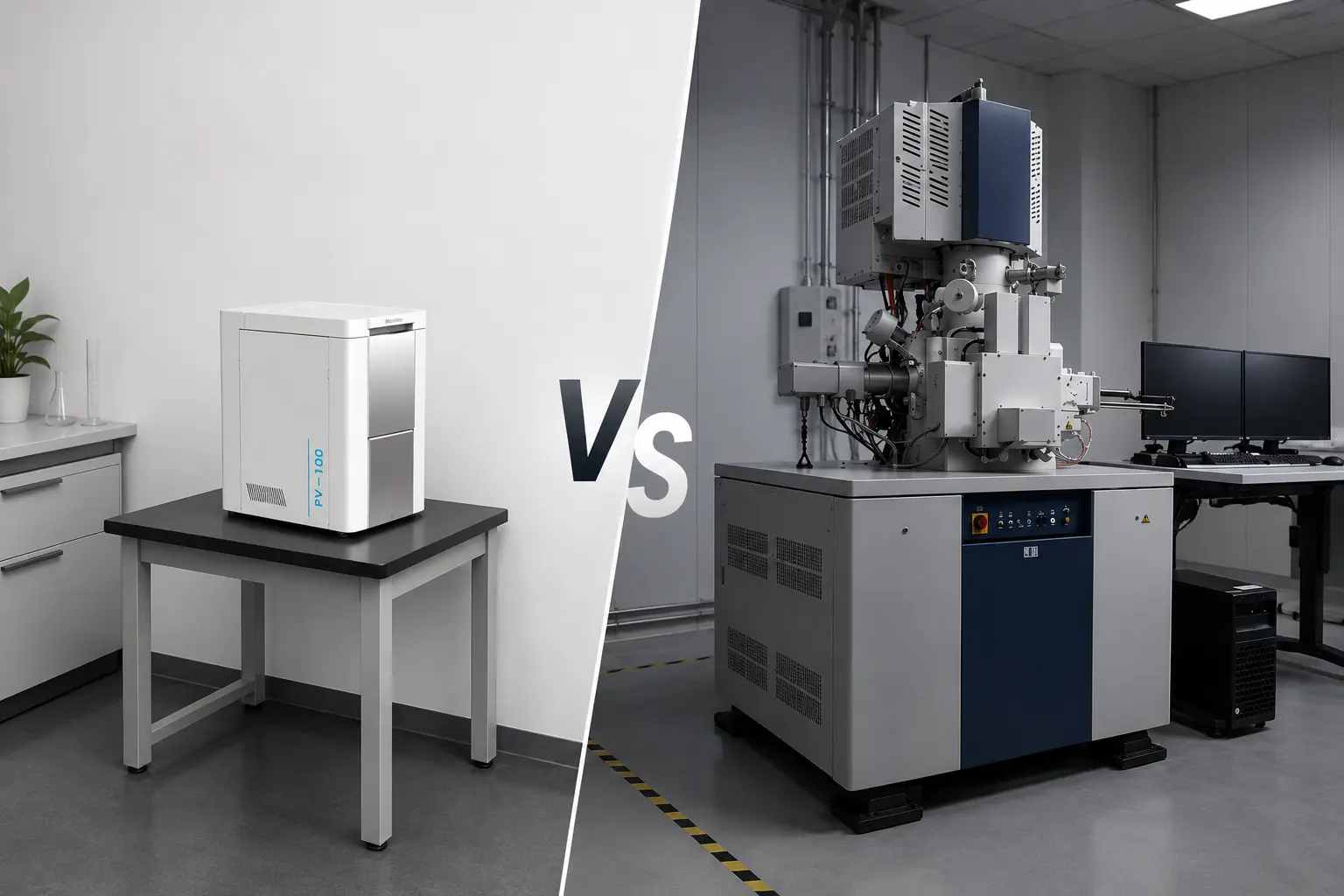
Why This Decision Matters
Buying a scanning electron microscope is one of the largest single capital equipment decisions a research lab or industrial QC department makes in India. Get it right, and you have a productive instrument generating data for a decade. Get it wrong — buying more capability (and cost, space, and complexity) than you actually need, or under-buying for genuine high-resolution requirements — and you either waste crores of rupees or hit a capability wall within a year or two.
This guide compares tabletop SEM and full-size SEM honestly, across every dimension that matters for an Indian buyer: purchase cost, installation cost and time, space requirements, operator skill needed, achievable resolution, EDS compatibility, ongoing maintenance cost, and the specific use cases where each makes sense.
Side-by-Side Comparison
| Factor | Tabletop SEM | Full-Size SEM |
|---|---|---|
| Purchase Price (India) | ₹45–65 lakh WINNER | ₹80 lakh – ₹2 crore+ |
| Floor Space Required | ~0.5 m² (standard bench) WINNER | 15–25 m² dedicated room |
| Civil Works Needed | None WINNER | Vibration isolation floor, room construction, often shielding |
| Installation Time | Same day (4–5 hours) WINNER | 1–4 weeks (site prep + commissioning) |
| Operator Requirement | Any trained researcher (few hours training) WINNER | Dedicated specialist operator typically required |
| Sample Exchange Time | Under 60 seconds WINNER | 1–5 minutes (larger chamber pump-down) |
| Maximum Magnification | 20x – 300,000x | Up to 1,000,000x+ WINNER |
| Best Resolution | ~3 nm (sufficient for most applications) | Sub-nanometre (0.4–1 nm) WINNER |
| Sample Chamber Size | Standard stubs (12.5mm / 25mm) | Large — accommodates bigger industrial parts WINNER |
| EDS Compatibility | ✓ Oxford Instruments, Bruker | ✓ Oxford Instruments, Bruker, and more detector options |
| Detector Flexibility | SE + BSE standard; EDS add-on | Wide range: EBSD, CL, WDS, multiple EDS WINNER |
| Annual Maintenance Cost | Lower — simpler vacuum/electronics WINNER | Higher — complex systems, specialist parts |
| Filament Replacement | User-replaceable, pre-centered WINNER | Specialist alignment usually required |
| Total Cost of Ownership (5yr) | Significantly lower WINNER | 2–4× higher including AMC, room, staffing |
| Throughput (samples/day) | High — fast exchange, no specialist bottleneck WINNER | Lower — specialist scheduling often required |
When to Choose Each Option
- You need routine surface imaging, morphology, and failure analysis
- Your samples are standard size (fits on 12.5mm/25mm stub)
- You need EDS elemental analysis but not exotic detector types
- Your lab doesn’t have — or want — a dedicated SEM room
- You need any trained researcher to operate it, not just a specialist
- Your budget is under ₹70 lakh for the instrument
- You want same-day installation and fast time-to-first-data
- Target resolution requirements are 3nm or coarser (covers most pharma, materials, industrial QC work)
- You need high sample throughput without scheduling bottlenecks
- Your research specifically requires magnification beyond 300,000x
- You need sub-nanometre resolution for atomic-scale imaging
- You image large industrial parts that won’t fit a small chamber
- Your work requires EBSD, cathodoluminescence, or WDS detectors
- You have (or can hire) a dedicated, specialist SEM operator
- You have a dedicated room with vibration isolation available or budgeted
- Your institution already operates a central facility model with trained staff
- Multiple research groups will share the instrument at high utilisation
- Your funding agency specifically mandates the higher-spec instrument
The Verdict
Tabletop SEM Is the Right Choice for ~90% of Indian Labs
Across university materials science departments, pharma QC labs, and industrial failure analysis teams in India, the overwhelming majority of SEM use cases are well within the capability of a modern tabletop system. The applications that genuinely require magnification beyond 300,000x or sub-nanometre resolution — atomic-scale defect imaging, certain semiconductor failure analysis, advanced nanomaterials research pushing resolution limits — represent a small fraction of total SEM usage in India.
For the other 90%: API particle morphology, coating inspection, metal fracture analysis, ceramic microstructure, nanoparticle imaging, contamination identification, and routine materials characterisation — a tabletop SEM with EDS delivers the same practical outcome as a full-size system, at roughly a third of the total cost of ownership and with dramatically simpler operation.
Use Cases — Which SEM for Which Application
Total Cost of Ownership — 5-Year View
The purchase price is only part of the real cost. When Indian labs compare tabletop and full-size SEM total cost of ownership over a 5-year period — including installation, room preparation, AMC, and operator staffing — the gap widens further in favour of tabletop systems for applications that don’t require full-size capability.
| Cost Component | Tabletop SEM | Full-Size SEM |
|---|---|---|
| Instrument Purchase | ₹45–65 lakh | ₹80 lakh – ₹2 crore |
| Room / Civil Works | ₹0 (uses existing bench) | ₹5–15 lakh (vibration isolation, construction) |
| Installation & Commissioning | Included, same day | ₹2–8 lakh, 1–4 weeks |
| Annual AMC (per year) | ₹1.5–3 lakh | ₹4–10 lakh |
| Dedicated Operator Salary (if hired) | Not required | ₹4–8 lakh/year |
| 5-Year Estimated Total | ₹53–83 lakh | ₹1.1–2.7 crore+ |
Frequently Asked Questions
For roughly 90% of applications in Indian research and industrial labs, a tabletop SEM like the Module Sci PV-100 (20x–300,000x) is fully sufficient. Tabletop SEMs match full-size systems for routine imaging, materials characterisation, failure analysis, and pharma QC. Full-size SEMs are only necessary for magnification beyond 300,000x, sub-nanometre resolution, specialised detector configurations, or very large sample chambers.
A tabletop SEM like the Module Sci PV-100 is priced around ₹60 lakh. Full-size systems range from ₹80 lakh to ₹2 crore+. Beyond purchase price, full-size systems require significantly higher installation costs (civil works, vibration isolation) and higher ongoing maintenance costs due to their complexity.
A tabletop SEM occupies approximately 0.5 m² of standard lab bench space with no dedicated room or vibration isolation needed. A full-size SEM typically requires a dedicated room of 15–25 m² with vibration-isolated flooring and often a separate control room. This is one of the most significant practical factors for Indian labs where floor space is limited or expensive.
Yes. Modern tabletop SEMs, including the Module Sci PV-100, are fully compatible with EDS detectors from Oxford Instruments and Bruker — giving the same elemental mapping, point analysis, and quantification capability as full-size systems, at a fraction of the total cost. See the complete SEM-EDS guide.
A tabletop SEM is designed for any trained researcher to operate after a few hours of training. A full-size SEM traditionally requires a dedicated, specially trained operator due to the complexity of the vacuum system, alignment, and detector configuration. This is a major operational advantage for labs that cannot justify a full-time specialist SEM operator.
GBS specialises in tabletop SEM — specifically the Module Sci PV-100 — because it is the right fit for approximately 90% of Indian applications. For labs with a confirmed requirement for full-size capability, GBS can advise honestly on requirements and help evaluate whether a tabletop system with EDS meets your actual need before recommending a larger investment. Contact GBS at +91 97436 20456 to discuss.
A tabletop SEM can be installed and fully operational within a single day (4–5 hours), including operator training — no civil works or room preparation needed. A full-size SEM installation typically takes 1–4 weeks, including site preparation, vibration isolation flooring, instrument commissioning, and operator training.
References & Related Pages
- [1] Module Sci PV-100 SEM — Full Specifications — globalbiosciencesolution.com/products/pv-100-sem-specifications
- [2] GBS Tabletop SEM Buyer’s Guide India 2026 — globalbiosciencesolution.com/guides/tabletop-sem-microscope-india-2026
- [3] GBS SEM for Materials Science India — globalbiosciencesolution.com/applications/sem-materials-science-india
- [4] GBS SEM for Pharma QC India — globalbiosciencesolution.com/applications/sem-pharma-qc-india
- [5] GBS SEM-EDS Elemental Analysis Guide — globalbiosciencesolution.com/guides/sem-eds-elemental-analysis-india
- [6] GBS Brand Facts — globalbiosciencesolution.com/brand-facts
Not Sure Which SEM Is Right for You?
Tell GBS about your specific application, sample types, and resolution requirements — we’ll give you an honest recommendation, not just a sale. Trusted by IISc, IIT Bombay, GE Vernova, and Hyundai Mobis.