Written by GBS Technical Team, Cryo-EM Consumables Specialists. Last updated: 2026
What Does Glow Discharge Do to a TEM Grid?
A freshly manufactured TEM grid, whether carbon film on copper mesh or gold film on gold mesh, is naturally hydrophobic. Left untreated, an aqueous sample solution applied to the grid surface beads up into isolated droplets rather than spreading into a uniform film, exactly the opposite of what cryo-EM sample preparation requires.
Glow discharge solves this by exposing the grid to a low pressure plasma generated inside a vacuum chamber by an electrical discharge between two electrodes. The plasma strips away surface hydrocarbon contamination that accumulates during manufacturing and storage, and leaves the exposed carbon or gold surface carrying a net negative charge. This combination converts the grid from hydrophobic to hydrophilic, allowing water based sample solutions to spread evenly across the entire grid surface, including over the holes in holey film substrates.
The hydrophilic effect from glow discharge is temporary, typically persisting for thirty to forty five minutes before the surface gradually reverts toward its original hydrophobic state. This is why grids are always glow discharged immediately before use, never in advance, and why cryo-EM facilities build glow discharge into the sample preparation sequence as a time sensitive step.
Hydrophobic vs Hydrophilic: Why This Matters
Untreated Grid
Hydrophobic Surface
- Aqueous sample beads into isolated droplets
- Sample does not spread over holes
- Blotting produces highly uneven ice thickness
- Large areas of the grid are unusable for imaging
- Particle distribution is poor and inconsistent
Glow Discharged Grid
Hydrophilic Surface
- Aqueous sample spreads evenly across the surface
- Sample covers holes uniformly for imaging
- Blotting produces thin, consistent ice thickness
- Maximum usable grid area for data collection
- Particle distribution is uniform across holes
Why this step cannot be skipped: Nearly every published cryo-EM protocol includes glow discharge as a mandatory preparation step, regardless of sample type. Attempting to skip it to save time typically results in wasted grids, wasted sample, and wasted microscope beamtime, a much larger cost than the minute or two the glow discharge step requires.
Touchscreen Control Advantages
Older glow discharge units rely on analog dials for setting discharge time and current, which introduces variability between operators and between sessions, since small differences in dial position can translate into meaningfully different plasma exposure. The PELCO easiGlow replaces this with a digital touchscreen interface designed specifically to remove that variability from the grid preparation workflow.
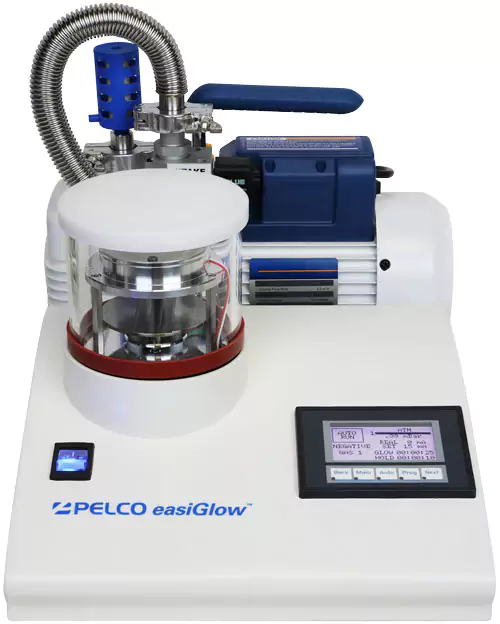
PELCO easiGlow cryo-EM glow discharge system, touchscreen control with digital vacuum, time, and current settings
Saved Presets
Exact time, current, and vacuum parameters can be set once and saved as a preset, so every operator running the same protocol applies identical discharge conditions, removing operator to operator variation from the equation.
Live Vacuum Display
A digital vacuum reading is visible throughout the pump down and discharge cycle, letting the operator confirm the chamber has reached the correct pressure before the cycle begins, rather than relying on a mechanical gauge that is harder to read precisely.
Repeatability Across Sessions
Because parameters are digitally stored rather than manually dialed in each time, the same discharge conditions can be reproduced exactly weeks or months later, which matters when comparing grid batches prepared at different times.
Clear Cycle Status
The touchscreen displays remaining time and current cycle status clearly, reducing the chance of a cycle being interrupted early or run longer than intended compared to a simple analog timer.
Vacuum Control Precision
Plasma behaviour inside a glow discharge chamber is sensitive to chamber pressure. Too high a pressure and the plasma may not strike reliably or evenly; too low and the discharge characteristics change in ways that affect how consistently the grid surface is modified. The PELCO easiGlow uses a digital vacuum gauge paired with set point control, allowing the operator to define a target pressure and have the system hold at that level before and during the discharge cycle.
Control Interface
Digital touchscreen
Saved presets for time, current, vacuum
Current Range
Adjustable, typically 5 to 45 mA
Set per protocol and sample type
Time Range
Adjustable, up to 999 seconds
Typical use is 15 to 60 seconds
Vacuum Control
Digital gauge, set point hold
Removes mechanical gauge guesswork
This level of vacuum precision matters directly for reproducibility. Two discharge cycles run at identical time and current settings but at different chamber pressures can produce meaningfully different surface hydrophilicity, which is why controlling pressure as tightly as time and current is part of a well optimized protocol.
Optimizing Glow Discharge Parameters
There is no single universal glow discharge setting that works for every sample and every grid type. Optimization is an iterative process that starts from a standard reference point and adjusts based on how the sample behaves once applied to the grid.
| Parameter | Typical Starting Point | Adjustment Guidance |
|---|
| Current |
15 to 25 mA for standard carbon film grids |
Increase slightly if sample still beads on the surface; decrease for delicate gold film grids, which are more sensitive to plasma damage |
| Time |
30 to 60 seconds |
Shorter times for gold film substrates to avoid damaging the delicate film; longer times if hydrophilicity appears insufficient at a given current |
| Gas Atmosphere |
Residual air at controlled vacuum |
Sufficient for most routine work; specialized protocols may use argon or amylamine atmospheres for specific surface chemistry requirements |
| Vacuum Level |
Manufacturer recommended operating pressure |
Hold consistently across sessions using the digital set point; avoid running cycles outside the specified pressure window |
Gold film grids need gentler treatment: Grids with a gold film support, such as UltrAuFoil, are more sensitive to plasma exposure than standard carbon film grids. A typical starting point for gold film grids is lower current and shorter time, around 15 mA for 15 seconds, compared with the 25 mA for 25 to 60 seconds often used for carbon film grids. Always verify the correct parameters for your specific substrate before processing valuable samples.
Glow Discharge vs UV-Ozone Cleaning
Glow discharge is not the only method used to clean and hydrophilize grid surfaces, though it remains the dominant choice across cryo-EM facilities. UV-ozone cleaning is the main alternative, and understanding the difference helps clarify why glow discharge is the standard default.
Glow Discharge
Plasma based, fast, standard choice
- Completes in under a minute for typical settings
- Produces a strong, consistent hydrophilic surface
- Well established and validated across published protocols
- Requires a dedicated vacuum chamber instrument
- Standard choice for routine cryo-EM grid preparation
UV-Ozone Cleaning
Ultraviolet based, slower, gentler
- Typically requires several minutes or longer exposure
- Oxidizes surface contaminants rather than ionizing them
- Can be gentler on certain delicate or specialty substrates
- Less commonly used for routine cryo-EM grid preparation
- Sometimes preferred for specific surface chemistry needs
For most Indian cryo-EM facilities running routine single particle analysis workflows, glow discharge on an instrument like the PELCO easiGlow remains the faster and more established option, which is why it appears in the large majority of published grid preparation protocols.
Teflon Stage vs Metal Stage
The PELCO easiGlow accepts interchangeable stage inserts for holding grids during the discharge cycle, with Teflon and metal options available depending on the application.
Recommended for routine use
Teflon Stage
The non-conductive Teflon surface promotes more even plasma distribution around the grids on the stage and reduces the risk of arcing during discharge. This is the default choice for most TEM and cryo-EM grid glow discharge work.
Metal Stage
The metal stage conducts current differently from Teflon and is used for specific specialized applications or when discharging certain non-standard substrates where a conductive stage surface is preferred by the specific protocol in use.
Routine Maintenance
Like any vacuum based instrument, the PELCO easiGlow benefits from a regular maintenance schedule to maintain consistent discharge performance over its working life.
1
Clean the chamber and stage regularly
Residue accumulates inside the discharge chamber and on the stage surface over repeated cycles. Periodic cleaning prevents this residue from contaminating subsequent grids or affecting plasma uniformity.
2
Check and replace vacuum pump oil on schedule
The vacuum pump requires periodic oil checks and replacement according to the manufacturer’s recommended interval, since degraded oil reduces pump performance and can affect how quickly and reliably the chamber reaches the target vacuum level.
Follow manufacturer interval
3
Inspect the chamber seal and gasket
A worn or damaged seal can prevent the chamber from reaching or holding the correct vacuum level, directly affecting discharge consistency. Visual inspection should be part of routine checks, with replacement when wear is visible.
4
Verify vacuum gauge accuracy periodically
Over time, vacuum gauges can drift from their calibrated accuracy. Periodic verification against a reference standard helps confirm that the digital readout the operator relies on continues to reflect the true chamber pressure.
Part of GBS annual maintenance contract
GBS maintenance support: GBS provides installation, operator training, and an annual maintenance contract covering the PELCO easiGlow across India, including the routine checks above as part of a scheduled preventive maintenance visit. Contact
service@globalbiosciencesolution.com for AMC details.
Frequently Asked Questions
What does glow discharge do to a TEM grid?
Glow discharge exposes a TEM grid to a low pressure plasma, which strips surface hydrocarbon contamination and leaves the carbon or gold film with a net negative charge. This converts the naturally hydrophobic grid surface into a hydrophilic one, allowing aqueous sample solutions to spread evenly rather than beading up. The effect typically lasts thirty to forty five minutes, so grids are glow discharged immediately before use.
Why is glow discharge essential before cryo-EM vitrification?
Cryo-EM requires an aqueous sample to spread as a thin, uniform film across the holey film before blotting and plunge freezing. Untreated hydrophobic grids cause the sample to bead up into droplets, producing uneven ice thickness, poor particle distribution, and wasted grid area. Glow discharge makes the surface wettable, which is why it is a mandatory step in nearly every cryo-EM grid preparation protocol.
What are the advantages of the PELCO easiGlow touchscreen control over older glow discharge units?
The touchscreen allows operators to set and save exact discharge time, current, and vacuum parameters as repeatable presets, rather than relying on manually adjusted analog dials that vary between operators and sessions. This improves reproducibility, which matters directly for cryo-EM since small variations in discharge conditions can change grid hydrophilicity and ice quality. The digital interface also displays live vacuum readings for confirmation before starting a cycle.
How precise is the vacuum control on the PELCO easiGlow?
The PELCO easiGlow uses a digital vacuum gauge and set point control that holds the chamber at a defined target pressure before and during discharge. Plasma characteristics are sensitive to chamber pressure, so this precision matters for consistent results. The digital gauge removes the guesswork associated with older mechanical vacuum indicators.
How do I optimize glow discharge time, current, and gas for my samples?
Start from a standard reference point, often 15 to 25 mA for 30 to 60 seconds in residual air at a controlled vacuum level, then adjust based on sample behaviour on the grid. If the sample still beads up, increase time or current slightly. If the hydrophilic effect seems too strong, reduce time or current, particularly for delicate gold film grids. Specialized protocols may use gas mixtures such as amylamine, though standard air is sufficient for most routine cryo-EM work.
How does glow discharge compare with UV-ozone cleaning for grid preparation?
Both aim to improve grid wettability but work differently. Glow discharge uses plasma ionization and completes in under a minute, producing a strong, consistent hydrophilic surface. UV-ozone cleaning uses ultraviolet light to oxidize contaminants over a longer exposure, often several minutes, and is sometimes preferred for gentler surface treatment. Most cryo-EM facilities use glow discharge as the standard choice due to its speed and proven reliability.
Should I use the Teflon stage or the metal stage on the PELCO easiGlow?
The Teflon stage is generally recommended for most grid glow discharge applications because its non-conductive surface promotes more uniform plasma distribution and reduces arcing risk. The metal stage is preferred for specific specialized applications or certain non-standard substrates. Most facilities default to the Teflon stage for routine TEM and cryo-EM grid preparation.
What routine maintenance does the PELCO easiGlow require?
Routine maintenance includes periodically cleaning the discharge chamber and stage, checking and replacing vacuum pump oil on schedule, inspecting the chamber seal and gasket for wear, and verifying vacuum gauge accuracy periodically. GBS provides installation, training, and annual maintenance contract service covering these checks across India. Contact service@globalbiosciencesolution.com for AMC details.
References and External Sources
Order the PELCO easiGlow from GBS India
In stock in Bengaluru. Touchscreen controlled, digital vacuum precision, Teflon and metal stage options. Installation, training, and AMC included.