Written by GBS Technical Team, Cryo-EM Consumables Specialists. Last updated: 2026
What Is Vitrobot Blotting Paper?
Every cryo-EM sample preparation session on a Vitrobot follows the same basic sequence: a small volume of sample solution is applied to a TEM grid, the grid is blotted to remove excess liquid, and the grid is immediately plunged into liquid ethane to vitrify the remaining thin film of solution into glass-like ice. The blotting step sits at the centre of this process, and Vitrobot blotting paper is the consumable that makes it work.
The paper consists of two pads that clamp briefly against both faces of the grid inside the Vitrobot Mark IV, drawing away the surplus liquid by capillary action. What remains is a thin film of sample, thin enough to vitrify properly and thin enough for the electron beam to pass through with useful contrast, but not so thin that the biological particles themselves are stripped away in the process.

Vitrobot blotting paper, medical grade, pre-cut for Mark IV pad holders
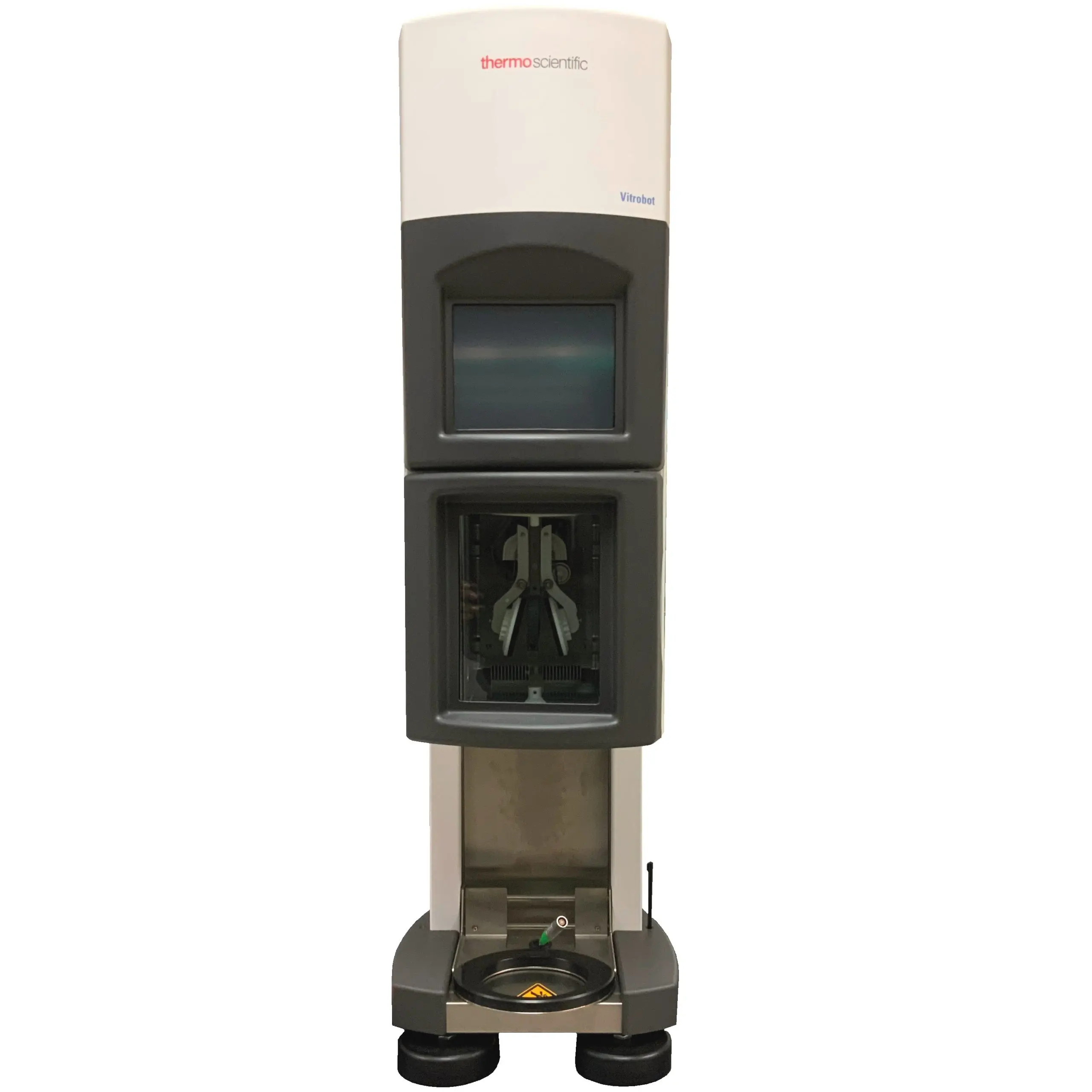
Thermo Fisher Vitrobot Mark IV, the instrument this blotting paper is designed for
Why Medical Grade, Ash-Free Matters
Not all filter paper is suitable for cryo-EM. The specification matters because the blotting paper makes direct physical contact with the exact grid surface that will later be imaged at high resolution. Any contamination the paper introduces becomes a permanent feature of that grid.
Medical Grade Purity
Manufactured to a controlled purity standard with tightly regulated fibre composition and manufacturing process, reducing the risk of chemical residues or manufacturing contaminants transferring to the grid during blotting.
Ash-Free Specification
Tested by combustion to confirm negligible inorganic residue is left behind, a standard proxy for how clean the paper is in practical use. Ash-free grades minimise the risk of mineral or particulate contamination on the grid surface.
Low Fibre Shedding
Cheaper filter papers shed loose fibres during handling and blotting. A stray fibre landing on a grid square can obscure particles in exactly that region, wasting the imaging time spent collecting data from it.
Consistent Absorbency
Uniform pore structure and thickness across every sheet ensures blot force and blot time translate into a predictable, repeatable amount of liquid removal, which is essential for reproducible ice thickness from grid to grid.
Pre-Cut for the Vitrobot Mark IV
Vitrobot blotting paper supplied by GBS arrives pre-cut to the exact dimensions required by the Mark IV pad holder assembly. There is no trimming, no cutting to size, and no risk of an ill-fitting sheet shifting inside the pad holder during a blot cycle. This matters more than it might first appear: an unevenly seated or slightly oversized sheet can cause uneven pressure distribution across the grid face during blotting, directly undermining the consistency the rest of the sample preparation workflow depends on.
Grade
Medical grade, ash-free
Low contamination, low fibre shedding
Cut Size
Pre-cut for Mark IV pads
No trimming required before use
Instrument Compatibility
Thermo Fisher Vitrobot Mark IV
Standard pad holder assembly
Storage Condition
Room temperature, sealed
Low humidity, away from direct sunlight
How Blotting Affects Ice Thickness and Particle Distribution
Blot force, blot time, and blotting paper absorbency together control how much liquid remains on the grid the instant before plunge freezing, which is the single largest factor determining final vitrified ice thickness. Getting this wrong in either direction produces grids that are difficult or impossible to collect good data from.
| Blotting Outcome | What Happens | Effect on Data Collection |
|---|
| Under-blotted |
Excess liquid remains, ice forms too thick across the grid |
Electron beam scattering increases, image contrast drops, fewer usable particles per micrograph |
| Over-blotted |
Too much liquid removed, sample stripped from some or all holes |
Empty holes, low particle count, wasted grid squares during automated collection |
| Uneven blotting |
Inconsistent contact pressure across the grid face, often from misaligned or poor quality paper |
Ice thickness varies across the grid, some regions usable and others not, reducing overall data yield |
| Well-blotted |
Thin, even ice layer with particles well distributed across the holes |
Maximum usable area per grid, consistent particle orientation distribution, higher data collection efficiency |
Beyond ice thickness, blotting also influences particle distribution within the thin film through the Marangoni effect, a surface tension driven flow that can sweep particles toward the edges of the blotted area during the brief period before vitrification. Consistent, even quality blotting paper reduces the variability this effect introduces, supporting a more uniform particle distribution across the imaged holes, which in turn improves the efficiency of automated data collection with software such as EPU.
Optimisation is sample specific: Blot time and blot force still need to be optimised for each new sample, buffer composition, and particle type. Good blotting paper removes one variable from the equation, it does not replace the need for a proper grid optimisation screen when starting a new project.
How to Change Vitrobot Blotting Paper
1
Open the Vitrobot chamber and access the pad holders
With the Vitrobot in a safe, paused state, open the humidity chamber and locate the two pad holder assemblies that hold the blotting paper against each grid face during the blot cycle.
2
Remove the used or saturated paper
Slide out the used sheet from each pad holder. Inspect for saturation, tearing, or visible sample residue, all signs that the paper was due for replacement.
Change after every 1 to a few grids, or when visibly saturated
3
Load fresh pre-cut paper into each holder
Take a fresh sheet from the sealed packaging, handling only the edges to avoid transferring skin oils to the blotting surface, and seat it into the pad holder. Because the paper is pre-cut, it should seat cleanly without adjustment.
4
Confirm alignment and close the chamber
Check that both sheets sit flat and evenly within their holders with no folded corners or misalignment, then close the humidity chamber and resume the blotting protocol.
5
Reseal remaining stock immediately
Return the remaining sheets to their original packaging and reseal promptly to limit exposure to ambient humidity, which is a particular concern in India’s climate.
Store sealed, room temperature, low humidity
Storage Recommendations
Vitrobot blotting paper does not require cold chain handling, but it does require careful protection from humidity. Store sealed packages at room temperature, away from direct sunlight, and in a low humidity environment where possible. In India, this often means storing the packaging inside a desiccated cabinet or a sealed container with silica gel, particularly during the monsoon months when ambient humidity in many cities rises substantially.
Once opened, reseal the packaging as tightly as possible after each use and avoid leaving sheets exposed to open air for extended periods. Paper that has absorbed ambient moisture will have altered absorbency characteristics and is more prone to microbial or particulate contamination, both of which can compromise blotting consistency and grid quality.
Handling tip: Always handle blotting paper sheets by the edges only, ideally with clean gloves. Skin contact with the blotting surface can transfer oils that alter local absorbency and introduce contamination exactly where the paper will touch the grid.
Order Quantities Available from GBS
GBS stocks Vitrobot blotting paper in pack sizes suited to both individual facility consumption and larger institutional orders. Because blotting paper is used frequently, most facilities benefit from ordering in bulk and setting up a repeat order cadence rather than reordering each time stock runs low.
Standard Pack
Routine Use
Suited to a single cryo-EM facility’s regular blotting paper consumption for day to day sample preparation sessions.
Bulk Pack
Recommended
Larger quantity for facilities running frequent grid preparation sessions, reducing per-unit cost and the frequency of reordering.
Standing Order
Institutional
Scheduled recurring dispatch set up with GBS, ensuring continuous supply without manual reordering for busy, high-throughput facilities.
Frequently Asked Questions
What is Vitrobot blotting paper used for?
Vitrobot blotting paper removes excess liquid from a TEM grid after the sample solution has been applied, immediately before the grid is plunge frozen into liquid ethane. The paper pads briefly contact both sides of the grid inside the Vitrobot Mark IV, wicking away surplus sample to leave a thin, even layer suitable for vitrification. Correct blotting is one of the most important variables in obtaining grids with usable ice thickness for high resolution cryo-EM data collection.
Why must Vitrobot blotting paper be medical grade and ash-free?
Medical grade, ash-free paper is manufactured to a high purity standard with minimal particulate residue and fibre shedding. Any fibres, dust, or chemical residue transferred to the grid during blotting can contaminate directly onto the sample area being imaged, obscuring particles or affecting data quality. Ash-free grades are tested by combustion to leave negligible inorganic residue, a reliable proxy for how clean the paper is in practical use.
Is Vitrobot blotting paper pre-cut for the Mark IV, or does it need trimming?
Vitrobot blotting paper supplied by GBS is pre-cut to the exact dimensions required for the Vitrobot Mark IV pad holders, so no trimming is needed. Pre-cut sheets load directly into the blotting pad assembly, saving preparation time and ensuring consistent sheet size and alignment across every blotting cycle, which matters for reproducible blot force and timing.
How does blotting paper affect ice thickness and particle distribution?
Blotting time, blot force, and paper absorbency together determine how much liquid remains on the grid before plunge freezing, which directly sets the final ice thickness. Too little blotting leaves ice too thick, scattering the electron beam. Too much can strip sample away or concentrate particles unevenly at grid edges through the Marangoni effect. Consistent, high quality blotting paper supports a more uniform blot and more even particle distribution across the imaged holes.
How often should Vitrobot blotting paper be changed?
Most facilities change the paper after every one to a small number of grids, and always when it becomes visibly saturated, torn, or shows sample carryover. Reusing paper across many blotting cycles increases cross-contamination risk and produces less consistent absorbency as the paper becomes wet. GBS supplies blotting paper in quantities suited to routine, frequent replacement.
How should Vitrobot blotting paper be stored in India?
Store at room temperature in original sealed packaging, away from humidity, dust, and direct sunlight. India’s climate can cause unsealed paper to absorb ambient moisture, changing its absorbency and potentially introducing contamination before use. Keep packaging closed until needed, and avoid handling sheets with bare hands to prevent oils transferring to the paper surface.
What order quantities of Vitrobot blotting paper are available from GBS?
GBS stocks Vitrobot blotting paper in standard pack sizes suited to both routine facility consumption and larger institutional orders, with ambient dispatch (no cold chain required) across India. Contact GBS at +91 97436 20456 or sales@globalbiosciencesolution.com for current pack sizes, pricing, or to arrange a standing order.
References and External Sources
Order Vitrobot Blotting Paper from GBS India
In stock in Bengaluru. Medical grade, ash-free, pre-cut for Mark IV. Ambient dispatch, no cold chain needed, across India.